by Sean MacPhee
So, Abby, there’s this boy.
There’s this scarf he has. It’s a little big, a little thick, a little soft. Turquoise, which he supposes is his favorite color. It’s four hours away and about four years old, knitted by a girl who he loved with as much of his little fourteen-year-old heart as he could.
At this moment, it’s sunset, and this boy is about four years ago and four hours away, looking at that scarf like it’s radioactive or the piece of Mars that his father bought a few years ago. He looks at the piece of Mars occasionally, a speck of reddish-orange dirt from another reddish-orange rock that’s a year of deathly cold space away. And while he likes to look at it, of course—it’s cool, you know?—he can’t quite compute what it means.
See, this boy, he’s a nerd. Geek. Whatever you call people who put on documentaries about the solar system while they play Call of Duty, that’s him. And he knows that Mars is lethal if you don’t take care. In the sky, Mars is blood-red. The ancient Greeks called Mars “Ares” and the Romans called Mars “Mars,” and both of them imagined a bloody and beautiful god of war. Of course, Mars is ultimately Death Valley if it refused to pay the heating bill.
This scarf has jack-all to do with Mars or space or anything aside from this boy. At least he hopes so. But it causes plate tectonics in his chest—sparks tension, bungee-cord-taut, somewhere to the right of his heart. He wonders as pieces of him sublimate if that’s how a suit rupture on Mars would feel, even if he also knows that’s ridiculous. See, this boy knows what that girl who he loved with all of his heart did. To herself. To him. He knows why that scarf won’t let go of him.
To be entirely fair, it’s hardly on a pedestal. He doesn’t have a bag of sand to trade for it either. Scarfy lives in the closet under some folded sweatshirts or hoodies. (I don’t remember anymore.) Most days, it doesn’t exist. Life goes on as normal. He eats, writes, games, sleeps, wiles his final teenage years away. But today, the scarf does exist, because today, he leaves for college—time to grow the fuck up.
Across from the closet is a shelf. It’s pleasant enough, pastel blue and yellow, a little childish. It’s pushed right up against the head of his bed. It holds loose change and old photos, knick-knacks and thoroughly outgrown books that he’d rather not disturb anytime soon. The shelf also holds the only other souvenir from his time with that girl he loved very much: a cheap plastic scroll with his name translated into kanji. He can’t for the life of him (and neither can I) remember the name of the festival they attended where he bought it. He can remember that she had something go awry at the end of the date, some tectonics all her own, another mood swing, and he’ll never forget the early-afternoon excitement that flash-fermented into mid-afternoon dread. It crept in on the metro back to where they’d be picked up, one section of black tunnel after another.
It would be a lie to say he was surprised. She had them all the time, she had issues, but the way she pulled back from him—god, the way she always pulled back. She didn’t mean to, but she chiseled home again that he couldn’t truly help, even though she told him he was salve enough. And really, it wasn’t his job to fix her. He didn’t want to fix her. Really. He just wanted to help.
“I love you,” my mother tells me sometimes, with a finger pressed against her pursed lips to help her think. “And I don’t like to see you in pain.”
That’s what came to mind on the occasion that he looked at that cheap scroll, the one time he unfurled it and stared blankly at the kanji. It means… the one who makes people smile? Light? Laughter? He knows it’s something there, between those three grab bag traits that he’ll put on a dating profile (probably), but he can’t place it. But her anxiety, worry in the back of his mind that maybe she’ll wind up in the hospital again, she’s hurting, and his best option is to leave it to her. That’s what returns.
Yet it’s the scarf he’s hidden in the closet. It’s the scarf that travels four hours with him into the next leg of his life. It’s the scarf that his thoughts meander back to. The vague memory of receiving it that he prays his mind hasn’t lost and reforged to assuage itself. Of course, the question that is naturally begged: Like, why, Scoob?
Now let’s flash forward.
They hadn’t been big on gifts. He gave her chocolate at six months with some chicken scratch he hoped was legible, which ended with, “And here’s to six months more!” Recollecting it even now makes him want to ooze down to the center of the Earth. The memory should be cute. He doesn’t know. He does know the smile that broke across her face, the kiss on the cheek she gave him that made him grin like a dope.
He also knows that a few weeks later, she told him she was in control, and that if he left, he didn’t love her.
He wants that note back so he can hold it to his chest. Not out of affection, but more like a cat trying to protect its territory from an encroaching vacuum cleaner. They haven’t been in the same room for three years by this point, but she hasn’t left his mind for more than a day at a time. It was a roaring victory that he didn’t think of her once on the anniversary of their breakup. A triumph that, like everything else, fermented into something that makes him look at his feet.
Maybe that’s why, then—reclamation. Make some new memories. Breathe in some new life. Make it his. Separate from her memory, like he didn’t make the fencing club where they met, the one her father owned. Take it four hours away to another state and bring it into another state.
In a way, he was right. He did the exact same thing as before, sequestered it in a drawer and (largely) forgot it existed. He had readings and workshops and “socializing,” whatever that meant now, so he was busy.
It’s about November. He’s in his room, his grand square plot of tiled floor and walls that are half plaster and half brick, alone. Except this night, however, is one of those where the scarf exists, and I think, at some point, he glanced at Scarfy’s new drawer.
There’s still one place he hadn’t looked at since she broke up with him: the texts. There’s an entire school years’ worth of his sublimation to save her, broken up into a million little boxes. “Good morning” texts and lunch texts and “good night” texts and a bold amount of “I love you”s for someone who couldn’t even get a learner’s permit.
He still remembers his perversion of himself. Trying to outwit her self-loathing, depression, trauma, whatever made her think she didn’t deserve the idea or thing du jour for that day. He had learned to tolerate the hollow tension that would bloom in his chest, the dismay and disappointment, because when he thought he’d finally found a way around to make her see, if only for a moment, that she did deserve to breathe, “I’m sorry,” she’d tell him. “You deserve better.”
He hated when she talked like that. It wasn’t funny. Because love, it isn’t about “deserve.” I don’t want you to be thinner or keep your hair down if you don’t want to. I don’t care if you’re not “my people.” I love you. I choose you.
She was drowning, and he was a poor life jacket. With each day that passes, he can’t help but feel a quiet horror whenever he thinks about that version of himself. The mini-fridge hums. His music is winding down.
Now, this is hardly the first time he’s thought of them. Heavens, no. However, each time he eyed that corroded merry-go-round of the past, he turned back at the last second. In the first few months, when the wound was raw, inflamed, creeping toward infection, there was probably some sense to it. But that wisdom couldn’t be extricated from the way the texts spurred on tectonics, scared him, like he’d gotten his foot stuck in a metro track.
And the scarf. He’d taken that scarf with him into his fresh start, the bright future she always told him he would have.
He doesn’t want to feel tense as he opens his phone, but there go the plates. But he’s strong, he can take it, so he only lingers for a moment, then scrolls up, searching.
And up he goes, passing those “good night” texts and the texts he sent to wake her up after she asked him to, because he made it easier. He scrolls all the way to January before he realizes that he isn’t seeing things. They’re gone. The night that’s dogged him for the past three years is gone. His texts, her texts, her declaration that she was in control, and if he left, he didn’t love her. All of it.
He makes some calls to family, goes for a run until his chest burns, and the runner’s high eases off some of the tension. Feels slightly better. Over the next few weeks, finals come and go, he talks about it with friends. He can remember giving her his phone after they broke up, briefly. He’d agreed before the split to coach at the fencing academy’s summer camps that year. She asked for it one day—never told him why. He can’t say for sure. He won’t go hounding after her for answers. But he hadn’t opened them in three years, and she’s the only one with a motive.
And in those few weeks, with a more still heart, and a 5 p.m. sunset filtering through his window, this boy I know opened his drawer. I think he might’ve taken the scarf into his hands, cradled it, his ill-golden fleece. It was as it always had been: a little big, a little thick, a little soft. He asked himself why it was here. What it meant to bring it here, into his future. When he left for winter break, he took it with him.
I don’t remember where he put it. I don’t want to.
But I need to. I have to. I have to stop that vacuum cleaner.
Or maybe, I can’t. Maybe it just stays there.
Maybe that’s enough. Mars isn’t going to crash into the Earth, right? Maybe being Mr. In-between is okay.
(I hope to God it is.)
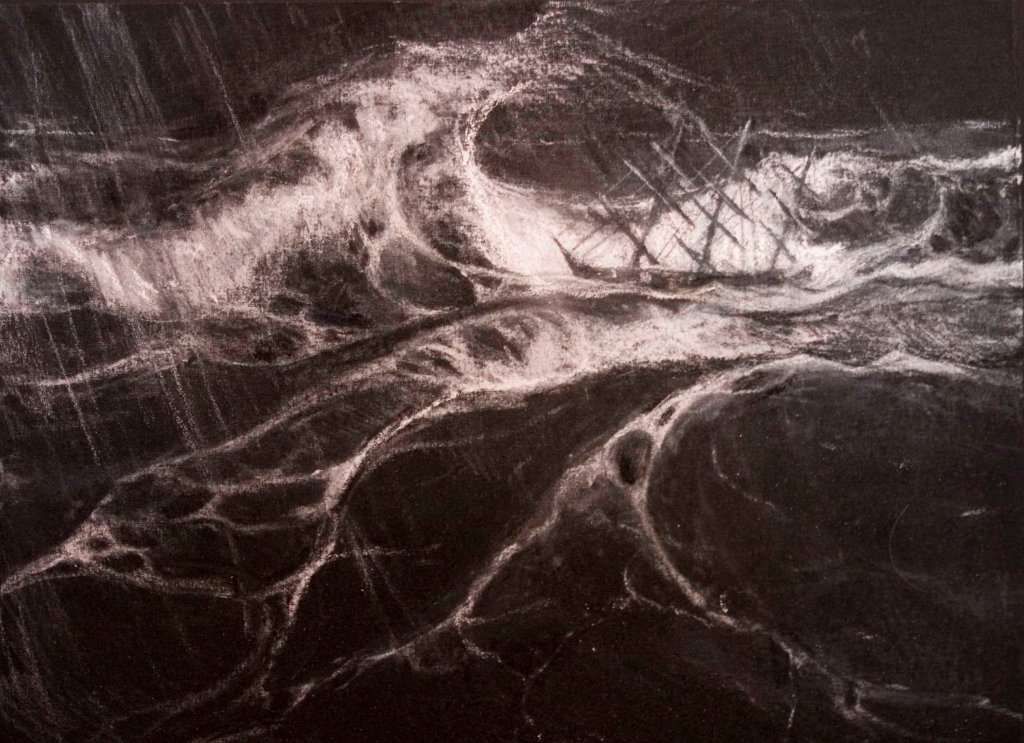
“Bos’n!,
by Edward Baranosky
Sean MacPhee is a graduate of Susquehanna University with a BA in Creative Writing with Honors. His short story “The Man in The Leather Coat” received a Silver Key in the Scholastic Art and Writing Awards. He has been published in Porter House Review, WILDsound Writing Festival, LEVITATE, and poetry anthologies. He was nominated by Dipity Lit Mag for the Best of the Net in 2025. He also won the Nocturne Ash Dark Poetry Contest.
Edward Baranosky has painted seascapes since he was seven years old. His focus on marine-scapes draws him back to visit his native home on the American East Coast for inspiration from the North Atlantic. His work emphasizes the present in the ever-changing moments of water. As a poet-artist, he crosses the channels and pathways between the visual and the textual. He continues to exhibit in the United States and Canada. Baranosky owns a small press, EAB Publishing, for poetry chapbooks and related material. He currently lives in Toronto, Ontario, Canada. He has several chapbooks of poetry, as well as journal and anthology inclusions, but no full published collection. At 78, he is still emerging. He can be found at painterpoet.weebly.com/


