
by Laura Booth
It began with Lewis Carroll’s “Jabberwocky,” creature fearsome and foulsome—who never succumbed, but rather jub-jubbed, headless, to the sea to terrorize me as I waded into waves for the first time—appearing in each monstrous, many-headed crowd, in the frumious gazes of the leather-faced men in their 4:3 armor, in every soldier prattling commands like an authority, hurling Virgil from far outside, feinting to go before missing the drop. Another misfire from the canon. Classic.
At first, the salt text was as opaque as those poems my bored high school English instructor plucked from the anthology and punted our way in a monotone—so much depending upon that red wheel barrow, glazed with rain water, beside those white chickens.
It wasn’t that I didn’t believe Mister Carlos Williams (there seemed, really, a glimmer of truth in it, everything depending wondrously, and—I admit—vexingly, on every other thing at once, that if I angled the board eversoslightly more north I could catch a wave, or if I watched the massive mome raths frothing wave spittle all the way from the point, I’d find a clue about a friendlier-sized monster making its burbling way to where I sat, shivering). It was just that it was so slippery, interpreting what depended upon what, and the interpretations had a way of shifting, like sandbars.
But looking around produced a shining awe—at the siren seals and lux glass-offs, cormorants doing tai-chi on the docks and the wrinkled wisdom of a wind-tousled home break on a smoke-salted morning, evoking a pang Mary Karr wrote about in her memoir, a sweetness “which fills the back of my mouth up with longing … like a thirst,” a wanting which too Edna St. Vincent Millay sang:
Feed the grape and bean
To the vintner and monger;
I will lie down lean
With my thirst and my hunger.
And this longing to understand, in turn, made it possible to persist in pursuit: How snackish waves are, the water is. Once in, I was IN, and insatiable.
So, for a long time, I just sat out there, reading, trying to tune my body, that inchoate wave-sensing instrument, to the sea. After all, “to be engrossed,” as Anne LaMott writes, “by something outside ourselves is a powerful antidote for the rational mind, the mind that so frequently has its head up its own ass.”
Which wave to paddle for? The beginner’s lament: a horde of Bandersnatches crowds the peak, my body too dumb still to sneak up and snicker-snack an unseen corner off, not yet discerning enough to write my own way. And when I’d get bold enough to choose one of those looming spines off the shelf, to paddle in—being called on, popcorn-style, by a friend-classmate, yelling, “It’s all you! Go!”—and drop in, bottom turn, momentarily reading so well, this oration giving me a sense of power and poise, a word—misanthrope, say, or sequestration—would backwash spectacularly, tripping me so I’d fall off, the board a reckless rocket somewhere above me and the spray, probably decapitating that local expert who’d laid into me the week before for yet another navigational mistake.
Still, I could see the humbling salt and laughing gulls were good for me. And, luckily, friends and mentors kept feeding me the keys to literacy: attentiveness, passion, obsession, humor, improvisation, creativity, envy, love. To watch good surfers reading waves is to bear witness to manifested intuition, embodied science that athletes and artists animate, a way of being that transcends oppressive forces.
Conqueror lineages committed genocide to squelch this mode of operating, but it lives on, and raucously. When a friend cross-steps by me in grinning concentration, “laughing shamelessly,” as C.D. Wright wrote, a flicking flame composing against a wave’s blue wall, double exposure of water and muscle, what can I do but take reverent note? I want to read like them, like that.
This aliveness makes a world I want to live in (much more than its barren, wave pool, electric skateboard alternative): a world where the kingfisher shaking its voice rattle is remarkable. It is obvious who in the lineup has entered that dream-realm of lightluck, of looking and seeing and hearing and feeling, whose language is pearl-violence, iridescence, nose kisses, pelicans.
Someone in the crowd is always reading the best that session, getting all the nose kisses. When they slide by, I hear Gwendolyn Brooks’ genius “We Real Cool,” all excess pared back—but the fat, the juice, left insistently intact: “We / Lurk late. We / Strike straight.” That person’s person lurking late before trimming a high, truth-telling line, body as paring knife harnessing an instant to make music with. It’s the mortality of the moment that’s vital—the ephemeral, under pressure, joined with style, makes culture.
Take that sublime spring night off the highway, where we felt transported to another country altogether, singing, Winnie-the-Poohishly, as we splashed in, “Oh, the honey bees are gumming on their little wings, and humming that the summer, which is coming, will be fun.” I ditch my leash, feeling for once like a grom—no one around would dare bust the smile off my face, a singsong generosity in the sunset air lifting off the horizon, seaweed snatching me off the board like Michael Ondaatje embraces his son, Griffin, in his poem, “Bearhug”: “Why do I give my emotion an animal’s name, / give it that dark squeeze of death?” My mother, after all, adored those white chickens loitering next to that old barrow. I feel the universe holding me round my chest with its fronds of seaweed arms—nothing a given, but everything, for a sweet second, safe.
Or that day when I felt like C.D. Wright wrote in “More Blues and the Abstract Truth”—“If I’m not seeing / a cold-eyed doctor it is / another gouging mechanic”—and asked, “How does a body rise up again and rinse / her mouth from the tap”? To stave off the void, I sluiced salt water against the roof of my mouth, plunging into rare small surf at Ocean Beach and found giddy relief: for the sherbet sunset, and the negative space between grasslands on Mt. Tamalpais, contrast so clear they made black type of the redwoods and scrub, a text or score I felt sure, with a little more study, I could read or play.
My literacy was okay that day—a special occasion when the log was really the only equipment, and the porpoises and I slipped into, leapt out of long peeling, pealing lefts. I felt my creative agency changing, my powers of expression improving through all that glorious exploration. The rhythm of sensations came clear, coherent and legible for pulsing instants, a palimpsest of wave erasure and others in dialogue. As the poet Joan Naviyuk Kane writes in “Nunaqtigiit (people related through common possession of territory),” “I began to accept my past and, as I accepted it, / I felt, and I didn’t understand: / I am bound to everyone.”
When I got tumbled near the end of the session, the whitewater rushing my ear drums, I thought: teach me Russian, and Spanish, teach me Mandarin, teach me ocean. I long to hear Ramaytush spoken, for the chance to hear every language, and for no language ever to die.
Fast forward to another day at another break some months later. I’ve read the Tidelog prologue, the Surfline foreword. I’m anticipating a new installment from a favorite author: west swell of a certain size, the period right. I know there are no guarantees, but feel glad to paddle out and see the usual suspects—the kingfisher, for one, in its pinwheeling flight, the shock of its crest like a wave breaking over the deck of my board.
And as I’ve seen before, titanic waves, those mome raths, are hurling themselves against the far point, crashing beside a flock of white chicken cliffs. I read closely and know there’s a good one coming, look around—no one else in this aisle of the library—so I paddle in, thinking of Whitman singing the body electric as I turn up the face and step down the board, suddenly knowing, ‘Twas brillig! and I am that Jabberwock, with eyes of flame, gyring and gimbling in the wabe wave, my body at home here, finding its own style, yipping for joy in a voice that could only be mine.
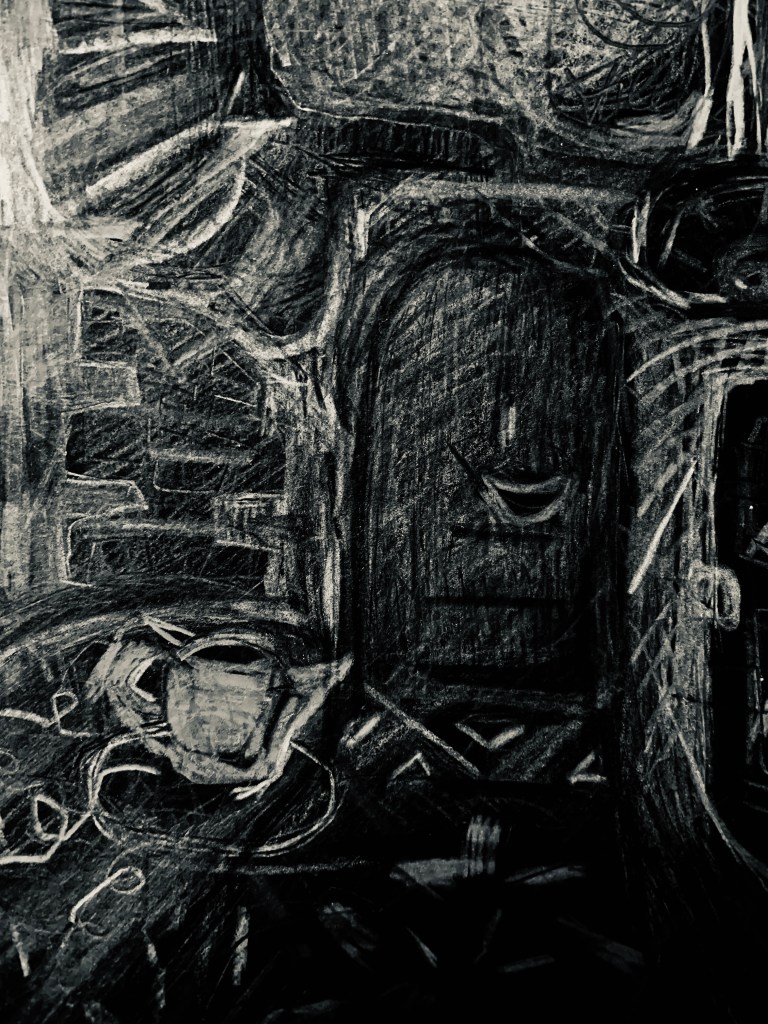
In Arles Apartment with the Smiling Door
by Rebecca Pyle
Laura Booth is a biologist working in the Golden Gate National Recreation Area and a student in USF’s Master of Science in Environmental Management program. She hosts an open mic at Black Bird Bookstore in the Outer Sunset. Her work has appeared in the West Marin Review and Emocean magazine.
Rebecca Pyle is a visual artist and a writer living in Northern New Mexico after two years of living and working in Europe, mainly in France. Her artwork—photographs, drawings, paintings—have appeared in West Trestle Review, New England Review, Vassar Review, Blood Orange Review, Dream Noir, and The Kleksograph. See rebeccapyleartist.com

 Ignatian Literary Magazine