
by Jackson Connor
During my first sophomore year of college, having recently joined the math major after giving up my pursuit of engineering, I spent a lot of time learning how to smoke cigarettes. An old-school autodidact by nature, I mostly learned through observing my peers, my family, and Robert De Niro. Categorically, I figured I’d need to know how to hold the damn thing between my knuckles while I was talking, which direction to tilt my head while lighting up, how and when to flick the butt. Most importantly, I knew that I had to develop my own style of whacking the fresh pack of smokes against my left wrist, forearm, or palm. After half a lifetime devoted to my body the temple, the religion of sport, the balance of health and something of a soul, I committed to making this change. I knew that, despite what Freud indicated, a cigarette was never just a cigarette, and the practice of artful smoking was a declaration of my self and my place in this world.
Among other wisely foolish pursuits that year, I joined a play, such that, unlike my first year of college, I stayed on campus during weekends and spent my Friday and Saturday nights learning to drink beer and leaning against the brick apartment buildings of baby thespians reciting lines from Monty Python, Pearl Jam, and, occasionally, the play we were to perform.
While my family was Winston full-flavor smokers from way back, everybody in Antigone smoked Marlboro Lights, leading me to my first major decision as a smoker. I faced choosing between the culture in which I was raised and the peer group I chose to define me. I considered my family who had built a happy childhood and granted me the freedom to explore even the most mundane aspects of humanity vs. this group of actors, relative strangers, with whom I really wanted to have sex. I even thought for a moment about striking out on my own and buying some Camel Wides, but, I’ll admit, I believed I had reached the limits of my cultural comfort zone and thought it best to abide by some institutional standards.
I was, at this point, building my future self and mostly just lonely, so I bought my first pack of Marlboro Lights—thoroughly white cigarettes from tip to filter, except for the thin band of silver that recalls the packaging, bright white, silver, bright white silver: they could have changed our college mascot to a bright white and silver cigarette butt flicked outside the frozen gymnasium that used to be a barn at the bottom of the hill, and most of my campus would have shrugged.
That’s how I remember college in Erie, Pennsylvania: lake-effect frozen, everything always frozen, everything covered in gray ash, cottony filters, and burnt matches. Erie was never quite Home, but it was close enough that my friends Dan and Ange would drive up to visit when the mill was down and the masonry was slow. I wrote my first short story that winter, a four-page masterpiece about this guy with long hair for the first time in his life and the outline of a goatee he’d often dreamed of, a wannabe lover, terrified of his own breaking heart, lonely and living in a dorm room and smoking cigarettes, a man child, vaguely concerned about a wart so big it effectively looked like another pinkie finger. I had read about a dozen short stories in my life and knew that there had to be an object that appeared throughout the writing for no obvious reason, but I had no knowledge of chrysanthemums or black veils, so my narrator kept talking about the cream-colored clay bowl with thin blue stripes out of which he ate microwaved oatmeal each morning. The story ends with our hero flicking his cigarette butt and stepping heroically into traffic—I mean the narrative just ends there, which should indicate to a discerning audience that, you know . . . he died. So cold, so lonely. I printed it up on my Brother Word Processor and stoved it deep in a drawer and didn’t write another story for three years.
All of this was before I’d wanted to “become a writer.” I was an engineering major, a math major, a secondary education major. I was in a play, learning to smoke, trying not to freeze to the world around me. I was a former athlete, a desperately virginal lover, trying to be whoever I was going to end up being while trying to carve out a space in the world to be this person.
In A Murder of Quality, John LeCarre writes, “Being alone was like being tired, but unable to sleep.” That’s how I was during my first sophomore year of college, lying in bed at two a.m., watching the Christmas lights we had taped to the ceiling fade from green to red to blue to orange to green. My best friend from high school was my dormmate. We had run a thousand and one cross country miles together, could fill an arena with our stories about our varsity basketball careers, had split cords of wood and walked miles of Allegheny shoreline together. But he was so lonely sometimes that being around him didn’t mean we weren’t both alone. Late at night we would walk outside the dorm to practice smoking and the Erie wind would bring frozen air into our eyes and ears. We’d tuck our faces inside our jackets and stand around in our flannel pajamas and smoke for half an hour or so, cracking the ice off the sidewalk with the heels of our running shoes, starting conversations about psychology texts and the female figure, then shrugging. The air bit at our eyes and ears and streaked our faces with frozen tears, despite our squinting. We’d shrug one last time, try to flick our butts across Lake Erie, and walk back inside.
One day, we went to the tobacconist at the Millcreek Mall. We’d never been to one before, and we were impressed. So much to see. I had the same feeling that moment that I get today, every time I walk into a library or bookstore—I want it all, I want to smoke it all, I want to read it all. My buddy and I smoked Marlboro Lights, but we were also connoisseurs of Philly Blunts—by which I mean, we always checked the expiration date, and thought ourselves clever about cigars. The tobacconist stood back behind the glass showcase, tugging at a black cigar the size of a school bus. He was scrawny with thin hair, a thin beard, and half a jaw, or, at least, a jaw so sunken that half of it lay in shadow. He had on a tie and a collar shirt that had probably once been whitish, and wore a forest green sweatshirt with an enormous puffy patch of an eight-point buck. Clearly, he had ethos with us on every level, so we asked him to compare some of the cigars in the humidors to, say, a Philly Blunt that hadn’t yet expired. He stepped us through some of the basic cigars—describing the band, the binder, the blend, the bloom—but we had little to say, except, “So it’s like a Philly Blunt?” or “So it’s not like a Philly Blunt?”
The somber cigarette packages behind the counter caught our eyes as well. Flat boxes, real cardboard, cursive print on the cover—now that, we nodded at each other, is a fancy cigarette. We asked the tobacconist to compare the fancy butts to, oh, say, a Marlboro Light. And he said, and this is the thing about that afternoon that really sticks with me—how poo-pooing somebody, while fun, can often be limiting—he said, “Oh. I don’t smoke cigarettes. I only smoke cigars and pipe tobacco,” and, now, I know, memory is a hell of a thing, wrapped up in desire and regret, nostalgia and misinformation, but this scrawny half-jawed, big-buck Eriean, said this with a royal British family accent. “I don’t smoke cigarettes, you wankers,”—the “‘you wankers'” was implied, and the “I,” it should be noted, was about three syllables long—He said, “I-ha-eee only smoke cigars and pipe tobacco.”
My buddy and I looked at each other and shook our heads as if to say, “Let’s get out of this piece.” Which we did, immediately after we bought two packs of fancy cigarettes, four cigars, a pipe and some pipe tobacco, specialty matches and a clever little cigar tool for nipping the ends and a funny little novelty book about the origins of pipes. Yep, we showed him, mocked the living shit out of him for days.
Five years later, I applied to grad school, having smoked ten thousand hours’ worth of cigarettes—walking to class between buildings that used to be family farmhouses; driving thousands of miles of I-79 between Home and school; in the break trailer at the refinery, listening to tired men speaking of youth and pulling on Pall Malls; sitting in a motel bed, stitching a wallet out of broke down corduroy pants; leaning forward in a moldy and duct taped office chair, threading hooks through forty-two farm-post-bar holes per minute; in cars, canoes, and living rooms; among friends, family, classmates, and coworkers—I smoked casually or desperately, quickly or contemplatively, tilting my head just so and flicking the butts a cumulative million miles or more, making me a master of the art, I believed, and leaving a history of ash and smoke on the landscape, tracing myself against the hills and streams or my life and my place. In the meantime, I had fallen in love, dropped out of college, fallen in love, worked in an oil refinery, lived in a car, moved to Montana, learned to snowboard, worked as a janitor, returned to Pennsylvania, fallen in love, worked for a telemarketing company, a furniture mover, a landscaper, a painter, and in a steel mill, reenrolled in college, fallen in love, studied abroad, written a tiny imitation of Jamaica Kincaid’s “Girl” that I called “If Dan Were in Charge of Running the 756 Press, This Is What He’d Tell You,” fallen in love, fallen in love, fallen in love, written a tight senior thesis which had grown out of a tiny imitation, graduated college, lived in a cabin on the river, written a novel manuscript called “I’ll Tell the Mill” which had grown out of a senior thesis, worked for a mason, and read and read and read, flicking cigarette butts at every ashtray, garbage can, and confederate flag I saw along the way. And, yet, when I started the grad school application process, this tobacconist is what I had in mind. I dialed up three grad programs on the telephone (I know it wasn’t a rotary phone, but it could have been for all the more I knew about the world), and asked each program to send me an application form. Each program responded—very pleasantly—“Oh, just go online and click . . .”
“Whoa, whoa, whoa, whoa,” I said, “I don’t know how to work the Internet.”
At which point, all three programs, in turn, in my memory, turned British, “You don’t know how to use the Internet, pet? Pity. Cheeky bastard. Quite.”
In truth, we had only put a phone line in down at the camp two summers earlier. This little cabin, sitting next to a tightly frozen Allegheny River tucked deep in a tight valley, was not ready for the Internet, and this suited me and my family just fine. This place did not demand to be googled, when everything we wanted to know about the world, we could discover by digging through the soggy guts of a maple tree, examining the cinder chunks we pulled from our fingernails, turning the onions in butter until they’re translucent. On the other hand, this was 2002, each grad program told me, and I would need to use the Internet to get by in my Master’s degree, and I dragged on my cigarette, pointed two fingers at the receiver, and said, “Doubt it, bud.”
Within a week, I received three dusty manila envelopes with pictures and maps and forms inside. One university had sent me a print screen from their website (I didn’t use the Internet, but I did understand some things), such that the form looked like this: “Full Name: ___(click here)___ Address: ___(click here)___” for three pages. I grabbed a sharpie and drew a giant picture of my own middle finger on each page. Ha! That’ll show them! Believe me, when I picked Ange up from his house and Dan walked from the steel mill and to meet us at the Corner Pocket Bar a few days later, we mocked the everloving shit out of grad schools. Fuck the Internet. I handed Dan those forms at the Corner Pocket. He sharpied a totally unrealistic set of genitals on them, then Ange lit them on fire to light our cigarettes. Pat, the owner of the bar was pissed that someone had set stuff on fire, but she saw it was us, so she goddamned us for a minute then cuffed our ears and pinched our cheeks. That moment, and a million others like it, are what I mean every time I say Home.
I submitted the other two applications, and sat on my hands for five months. More to the point, I wrote and revised “I’ll Tell the Mill,” and I chewed tobacco and drank instant coffee, and, because I had shot a deer that year, I ate deer meat with my Spaghettios. I thought about getting the Internet, but where would I put Sometimes a Great Notion, if I got the World Wide Web installed?
This was the coldest winter of my life, colder even than any Erie winter, far colder than my snowboarding Montana winter. The river froze solid, and, though legend told us the Allegheny never stayed frozen past 19 February, this year it was covered in ice well into March. I had no ideas about who I might be in the future, no ideas what to do with any given day, such that when Angelo and Dan came to visit me one day in December, we took a sledge hammer, a spud bar, and an eight pound maul down to the river and chipped the ice away at the shore and went swimming in our underwear: that wasn’t like us at all—all three of us knew the river well enough to be terrified of it at its shallowest moments in the middle of summer—but we made a vow to do it each year at that time for the rest of our lives, even signed a paper.
Towards the end of March, I got a call from somebody at “The University of Utah,” telling me I had been accepted into the program and had earned a fellowship. The voice, even as he said his name, sounded vaguely French and vaguely Jewish, not unlike the voice Dan often used when he needed a rabbi in his joke. I was four beers into a Thursday evening, and I knew that people at universities don’t call you at seven p.m. I also knew Dan was on break at the mill. I felt as though he was laying it on a little thick. I mocked up the accent, “Okay,” I said with my own French Jewish accent, “when do I begin?” I sounded, I’ll admit, a little bit like Dracula. He told me orientation was in the middle of August and classes start the last week of summer. Dan had clearly thought this through. I asked him to repeat his name, and he did. I asked him to spell his name, and he did, and it sounded like a name I knew from the application forms. I told him I’d call him back the next day with my answer. He gave me a Utah number and apologized for calling so late, but the two-hour time difference throws everybody off once and a while—such a prank was above Dan’s pay grade.
As soon as I hung up with François, I called the steel mill, spoke to a few guys I knew, and asked one to get Dan. I mocked up the vaguely foreign accent, and he said, “What the fuck are you doing?” I told him I thought I had just been accepted to a grad program and he congratulated the hell out of me. He told me to drive into town, he’d take a few hours off work and get me a beer. I met him and Ange at the Corner Pocket, high fived a little bit, smoked a few cigarettes, and talked about the future. Ange said, “So where’s this grad school at?”
I said, “Salt Lake City, Utah.”
Dan said, “So you’re moving there?”
I said, “Yeah, I figure I’ll pack up and head out in two weeks.” His face went a touch slack for a second or two, then he smiled and slapped me on the shoulder such as to say, “Way to go, bud,” and I wouldn’t realize it until I wrote this line, but that was effectively the end of my fifteen-year friendship with my two best friends. They came down to the camp the next weekend, and we played cards all night with my folks, then I drove to Utah to become a grad student and left the mill and the masonry to Dan and Ange. We never followed up on our vow to swim in the river each winter, though I still have the paper we all signed.
The trick to smoking a good cigarette is not really a trick, but a talent. Patience is key: if you look like you’re in a hurry to light up or puff down a smoke, even amateurs will doubt your ability to relax, and they’ll know in their hearts that your whole life is a sham. Skip the designer smokes, also, for similar reasons, but be sure that every motion is fluid, as if, if you hadn’t lit the cigarette just now, it would have lit itself, such an extension of yourself it should be. I’ll admit that I haven’t been a full-time smoker since I got to Utah, but when I have lit up over the past decade, I’ve thought of Home—the place, space, time, and mind that created me as I created it—remembered the tightness and desperation that those hills and valleys brought to me, the consistency and change a river demands. I’ll also just tell you this, don’t be discouraged if you’re not an avid smoker after your first pack. These things take time, and before long, you’ll keep that knowledge stoved deep in your gut, and no matter what anybody says to you, whether it’s disparaging of your habits or upbringing, whether it’s a criticism or a witticism, whether it’s the truth as you know it or the truth you don’t want to hear, nestle that butt between two knuckles just so, tilt your head at just such an angle each time, and your muscle memory will always land you firmly back Home.
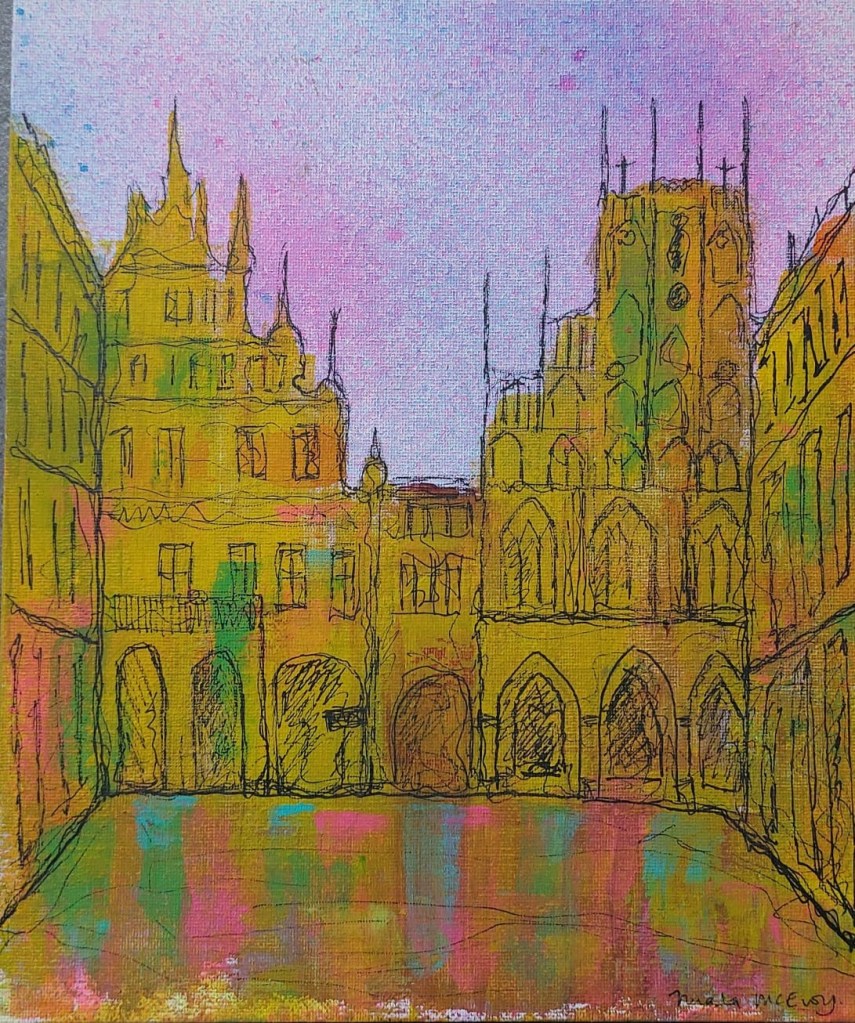
Brigita’s Rathaus
by Nuala McEvoy
Jackson Connor lives and builds in Pittsburgh with his spouse and youngest child. Later today, he’ll likely set a tub and hang some Hardiebacker, finish prepping for tile. In other moments, he worked as a firewatch in an oil refinery, a scale pusher in a steel mill, a hoddie on a masonry crew, and a laborer for a half dozen other builders. His PhD is from Ohio University, and he is willing to sell it to anyone who will pay off the balance of his student loans, OBO.
Nuala McEvoy taught herself to paint during the pandemic at the age of fifty, and what was originally intended to be a gentle hobby has since turned into a passion for her. Her work now appears online, in places such as Red Ogre Review, Quibble Lit, Free Flash Fiction, Londemere Lit, Underbelly Press, and Heimat Review. She has work upcoming in The Chestnut Review, Does it Have Pockets, Through Lines, and Ink in Thirds. She has two exhibitions of her work in Münster, Germany, where she currently lives. She was recently interviewed by The Madrid Review about her creative process.


