
by Theo Fox
Perhaps it was their sad, triangular eyes, or the way their waddling bodies bobbed in and out of the field of view of his binoculars, but every time Eli settled down amongst the heather-dotted rocks to observe the puffins, instead of feeling voyeuristic he felt exposed.
The afternoon ocean smashed into the sandstone column supporting the seabird burrows, a rhythmic roar of salt and hunger, habitat and grave, sediment and slow erosion.
The natural world contains so many violences we can only name and define, categorize and file under a subset of a subset of a phenomenon too large to be called anything except “the way things have been and will always be,” because to call them violences would render entire environments inhospitable, would wrench the safety from our brick-and-mortar houses, would mean the violence has always been all around us, several orders of magnitude above the level of danger with which a human being can everyday cope. We call them geological processes, wind abrasion, glacial plucking, marine weathering, gravity. If we called the crushing pull of our bodies to the earth a violence, we wouldn’t be able to get out of bed.
On islands like Clach Aghaidh, the focal point of a crescent-shaped archipelago in Scotland’s Firth of Forth, the rocks bear witness to the force of the sea. In each direction Eli could face, sea stacks rose out of the ocean, great vertical columns that used to be island and would soon be submerged. Even the coastal headland on which Eli lay, belly covered in thin soil, showed signs of the ocean’s mechanical onslaught. Cavities in the cliffside were beginning to broaden into cave mouths, which would collapse into arches of stone, which would succumb to gravity, that force that made the universe quiver into semi-ordered being, eventually crumbling into stumps of rock the ocean might easily conceal at high tide. In his more playful moments, Eli liked to imagine them as toe-stubbing sites for giants. Now, his elbows aching from hours of propping his skull up in order to look through the lens of the binoculars, the invisible stumps seemed like one more danger lurking in the shallows, a reminder of what repeated exposure might effect onto even the stoniest facade, given time and a lack of interference.
The sound of boots crunching through the seacliff grasses behind him. He pressed his face closer to the frame of the binoculars, eager to delay the moment of interaction as long as possible.
“Hey, Eli.” He didn’t like how the other man’s accent shaped his name, the hard “i” drawn out into something softer, the “ih” of win, of fix, of women. It wasn’t Kristofer’s fault that the way he spoke his name made him uncomfortable, but it was a hard-won name, and he wished he could cherish its use rather than feel like slinking away into the fronds of the sea plantains surrounding his vantage point on the rocks.
A soft fwump as Kristofer’s rucksack hit the ground, his knees following, silent except for the sound of the creeping red fescue rustling like so many unsheathed swords slicing through the air. Eli finally turned from the squabbling puffins, the strap of the binoculars taut against his neck, lens focused and pointed but for the benefit of no watching eyes.
His colleague was unpacking his own observation kit, but paused to grasp Eli’s right hand in his, a friendly and equalizing gesture that erased some of the sting of the misnomer. Kristofer was blonde, gangly, all collarbone and wiry muscle, built in just the way that made Eli appallingly jealous, desperate to turn his own DNA inside out and strip it with a paring knife until the curves were gone, the rounded lines unbent, arches and swells reduced to perpendiculars and strictly vertical planes of motion.
“Any of them looking peaky?” Kristofer indicated towards the birds with his eyebrows. Eli shook his head. He had been at the nature reserve for nearly six weeks, observing pelagic seabirds’ cliffside behaviour and trying to gather enough information to decide which species he would focus on for his research project. The puffins were by and far his personal favourite–he couldn’t get enough of their underground cities, the way they burrowed into the earth and then turned to stare out of their tunnels like kept animals–but he wasn’t sure enough of them would survive the season’s fledging to provide a sustainable sample size. Nature had ways of picking them off, and not by means that were useful for his studies. Gulls, for example, invading the burrows and making off with unsupervised chicks, or the Arctic skuas, kleptomaniacs dead set on surviving by stealing mouthfuls of sand eels from parents returning to the nest. He couldn’t bring himself to watch the puffins retreat into their tunnels with empty beaks, victims of an unjust natural cycle of which they had no understanding. At least if one died of a slow-growing tumor he could highlight it in his lab notes.
A series of moments passed with the two of them lying there, awash in the crashing of the waves, shoulder to shoulder under the mid-June air. Occasionally, a puffin would come in from hunting, wings outstretched against the sky, bright orange bill flashing in the sun like a beacon for potential mates and predators alike. In the winter, when they retreated back out into the open ocean, their signature orange markings would drop away, allowing them a measure of safety to blend back into the winedark waves and live until the next spring. It was dangerous to be visible, to have your existence noted by something moving under the surface. But even more dangerous was to disappear entirely: without several months of seeming vanity, colourful plumage drawing increased attention on the cliffs, the species would die out. The clowns of the sea, imperiled or erased no matter whether they chose existence or disguise.
Eli’s phone buzzed in his shirt pocket. He checked the text as his colleague continued to peer at the colony across the water, waiting for the appearance of a downy puffling or a threatening silhouette on the wind. It was Jill, his supervisor, sending out a group alert about the impending high tide that would make certain areas of the island inaccessible until the morning, a necessary warning for anyone doing observation work in the northernmost tip where the sea stacks were most closely clustered and where a gully lay across the trail that led back to the conservation center. Jill was a mid-career researcher ostensibly about to experience the prime of her work, a period filled with opportunities for chair nominations and grants and renown in her field, and yet things kept delaying that prime. Trivial things like half a colony of terns she was studying suddenly migrating to a new island midway through her data collection process, or the adjudication committee failing to meet to approve her promotion according to schedule because of a semester-long faculty strike, or one of her former students, Stephen Shaw, becoming embroiled in some vaguely misogynistic controversy when he had drafted a letter in support of a colleague just after taking up his first postdoctoral position. Eli sensed that she was coiled up, ready to snap at the first sign of another issue arising, even a minor one, and was adamant that he would not be the person who flubbed the results needed for her latest article to go to print. He might be a slow decision maker in terms of his doctoral focus, might need a little extra prompting and chasing down to finish his comprehensive exams on time, might not be brilliantly original in his insights even, but he was a good scientist, a sturdy worker and communicator, and as long as he kept plodding along, his goals would accomplish themselves. An endurance game, that’s what people called it. Who can keep their head above water the longest?
He conveyed the alert to Kristofer, who nodded, taking a sip of water without moving his eyes from the binoculars.
“I think Seb was out there today, said he was packing lunch when I saw him at breakfast,” Kristofer said. Then, nonchalantly, “Also said you two were celebrating a birthday last night. Yours?”
Before Eli lied, there was no moment of consideration, no balancing the consequences of the truth versus an almost imperceptible fib. He didn’t even really do it out of concern for his safety; Kristofer was a friend, trustworthy enough in the month and a half Eli had known him, comfortable socializing at the centre-sponsored weekly gatherings but also focused mainly on his work. Eli liked that, appreciated that he wasn’t out to extract information about potential rivals, to attempt to intimidate, blackmail, or otherwise bully those he worked alongside, behaviour Eli had seen exhibited frequently enough in the vicious world of university laboratories where slots for graduate students were limited and privately-funded scholarships even more so. Kristofer wasn’t the issue. It was more habit, the way the lying happened, the fiction moving through him like water through a hose; the faucet was off, then it was on, an act less of intention than of muscle.
“No, no, I’m February. Yesterday was,” he took a deep breath for effect, looking appropriately traumatized, “my kid sister’s. She didn’t make it, so every year I have a memorial, light a candle, you know.”
Kristofer shifted his weight on the bluff, looking uncomfortable with the conversation he had brought into being. “God, I’m sorry. That’s rough.”
The lie worked because it tended to halt further discussion. But it also worked because it was close enough to the truth that it didn’t really feel like a lie–if you drew a Venn diagram of the two, it might be the single intersecting point, at least when viewed from certain angles. After all, in his mother’s eyes, he had killed her. That girl.
It wasn’t really how he felt, that complete disconnect between past and present, discontinuity of the self, but then it wasn’t entirely wrong either. It was as though he had gone for a very long walk while under the effects of anesthesia and now remembered only fragmentary glimpses of times he had looked around him and thought, wow, I’m so awake. He had started somewhere very different from where he was now, but it was long enough ago that the edges were beginning to erode, sediment melting away into blurry before-time. That was the reason he found talk therapy so difficult; how had he felt about toys, clothes, his parents, other children on the playground at only seven years old? He wasn’t even sure he remembered anything about being seven, except perhaps a general sluice of dependence, the childhood discomfort of mandatory schooling, poking mud at the edge of the playground with a stick, exaggerating to the student teacher about how mean the other kids were to him. But even then he was Eli. Eli alone on the monkey bars, only he didn’t yet have the name for that, because certain things you could only see in retrospect, like you had one eye for the past and one eye for the present and had to adjust them individually and if you tried to view them with the same focus, you wouldn’t be able to see a damn thing at all.
They had lapsed into silence again, vaguely aware of a nearby group of volunteers wading through the underbrush in search of invasive plants to uproot. The island’s governing authority took external contaminants very seriously; on their arrival from Tarbet, a town only about 11 miles away on the mainland coast, the ferry had been under close inspection by a warden appointed by the Scottish Wildlife Trust. The seabird centre relied upon a constantly rotating international stock for its research teams, emerging scientists mainly funded by North American universities, but a single rat or weed from the closest mainland village threatened to devastate the ecosystem that allowed the seabird populations to flourish here. Even now the volunteers were hacking back a tree mallow shrub, its lilac petals shaking as several people seized it at once and began the slow process of ripping its roots from the ground. Over here, on the windswept bluff, it looked harmless, delicate even, but if allowed to spread, its tangled shoots would block access to the underground burrows by autumn, and the puffins would cease to visit Clach Aghaidh.
Kristofer swatted his hand in Eli’s direction suddenly. “What is that?”
He motioned towards one of the rightmost burrows on the sea stack. The sandstone rose at an angle, and so it was possible, from the right vantage point, to see further into this burrow than many of the others, which were obscured by low-growing flowers or grasses. Eli adjusted the focal distance on his binoculars, trying to get a closer look at the thing flapping in the wind outside the entrance to the nest.
“Is that…newspaper?” The thing was flimsy and he was still much too far away to make out any details, but it looked black and white, potentially capable of forming letters.
“Maybe,” Kristofer paused. “It looks like strips. Look, there’s more of them.”
A wind had caught the edge of the nest and buffeted more mysterious scraps into the air where they hung, birdlike, for a moment before descending towards the waves in an oscillating pattern: left, right, left, right, plummet, drown.
Eli watched the paper shreds submerge and vanish into the current, tugged underwater by unseen influences. He had taken several classes on marine life, preparing to study deep-sea creatures before the pelagic seabirds captured his interest, and had learned that our understanding of the ocean is fundamentally based upon the kind of image you might see in a picturebook alongside a medieval structure with invisible walls that allows you to follow the activities of each member of the household. Scientists conceptualize an imaginary column of water descending from the surface to the clefts in the earth’s crust, with slices of varying depth, salinity, micronutrients, and so on. They call it the pelagic zone, consisting of regions demarcated by light: sunlight, closest to the surface, the primary area in which nutrients are produced; twilight, full of bioluminescent creatures that rise at night to feed in the sunlight zone like so many vampires; midnight, whose population survives solely by consuming detritus that falls from above like snow; abyssal, the first region of utter darkness, consisting of the transparent and eyeless; and hadal, so named for the Greek underworld, from which no one can escape. It had always seemed odd to him that these incredibly varied chunks of the ocean were held together under a single category, non-pelagic zones being the areas too close to shorelines, coasts, the seafloor, the boundaries between their world and ours. But recently he had begun to see their point, to understand why so many seabirds slink back, at the end of summer, into the open ocean, refusing to alight on land until the winds compel them in mid-March. Pelagic means unrestrained, unhindered by the barriers of underwater topography, free to swim in any direction you chose. And puffins, with their short wings and stout build, swim like they’re flying.
He and Kristofer stared for several more moments, as though the force of their gaze might summon the scraps back out of the sea, reverse the effects of water on paper. Eli had seen up close how a few drops of liquid rendered the hardiest paper flimsy, fibers stretching and pulling apart from each other like so many ligaments. There would be no coming back from the ocean.
“Well.” Eli scrambled onto his haunches, the backs of his thighs burning as they pressed against his ankles after many hours spent in horizontal observation. “I don’t think I’m going to beat that today, in terms of intrigue. Lunchtime before I have sequencing with Donaldson.”
Kristofer continued to look out at the sandstone colony across the bluff as Eli packed up his binoculars, tripod, and data journal, the various tools that made surveillance possible. He was glad for it, relieved not to have the other man’s eyes on him as he fumbled with the clasps on his rucksack, or made a show of fumbling with them. The truth was he knew exactly how to snap the golden fasteners into place, the pressure one needed to maintain with the index finger while a thumb slid the metal towards a satisfying click. But he always pretended to struggle with this simple act, misjudging the angle of their joining or even missing the clasp altogether and skating the tongue along the waxed canvas, metal searching across a surface for which it is entirely unsuited. It was playing at clumsiness, or perhaps performing the idea that things weren’t always easy, smooth, and it afforded Eli a moment to grin sheepishly, look entirely uncalculated, as though he wasn’t finely managing every single twitch of his muscle fibers when existing around other people, his body meeting natural friction as bodies do when they move through space without the careful choreography of a life spent wanting to be otherwise.
Friends though they were, Eli found it difficult to be with other people, even a quietly friendly presence like Kristofer. Being around someone meant being constantly open to new lines of attack: conversations opening out of the blue, or worse, dying off into the awkwardness of failed connection, murmured agreements and nodded “yeah”s that meant whatever friendship you had, whatever solace you drew from one another’s company, there was always a line you could not cross, an interest you could not feign. The crushing pressure of attempting to ask the questions someone hoped you might ask, to steer the conversation into the waters in which they were happy to float, the only alternative being a silence that stretched, moment by moment, into a realization of failure, of your inability to entertain, of the fundamental selfishness you frequently suspected in yourself finally coming to surface. When Eli did not know what to say, he closed his mouth. Just last night Sebastien had been rambling about his favourite band back in Montreal, post-ambient prog-rockers whose entire discography was some kind of allegory for either Christ’s journey to earth or descent into hell—Eli hadn’t caught which—and had suddenly turned towards him, hands on his knees, and asked, very seriously, which research publication they should read over together, since if they couldn’t entertain each other with their actual interests they could at least bond over the latest studies on cell death in naked mole rats. Eli’s bouts of muteness were perhaps the one behavioural flaw he could not prune away with attention to how others careened through conversations, not caring which topics they smashed into or whether their partners found the safe harbour in which to discuss their interests. He could not perform away the simple fact of disinterest. Being with others was a constant ripping apart and reattaching of the velcro-like bonds between people, whereas being alone was quiet, smooth, only the same material ever at odds with itself.
“See you at dinner. Text me if grandma puffin takes a tumble, okay?” Eli swung his bag onto his shoulders, sneakers leaving minimal markings in the soil that managed to coat his every article of clothing yet somehow refused to be worn away by the eroding winds.
“Yes, bye for now.”
Head low to search the path for potential tripping hazards in the underbrush, Eli made his way along the bluff trail, headed not towards the research building, but the town centre. As he left the cliffs behind, the vegetation beneath his feet shifted, moving from the salt-tolerant shrubs that could sink their roots into any windy outcropping to the flowering plants that required richer soil, a less exposed setting, a more tenuous grasp on their surrounding environs. The visitor information center had a volunteer contingent dedicated solely to promoting the island’s thriving population of maritime grasses. Eli thought it odd, the fixation on flora when the fauna were so celebrated already in the scientific community. Still, he supposed the island had sustained generations before pelagic seabirds became an in-demand research topic. Each gulley and sea stack on Clach Aghaidh had its own name, though he knew very few. He tried to imagine granting such tremendous care to any one landscape, its raised topographies and dipping terrain, and found he could not. He simply did not have the history–too few roots in one place. But the island’s residents, many of whose families had been farming the land for centuries, would sometimes, if it was late in the pub and a few rounds of drinks had been covered, speak of long hours huddling in caves, waiting for the sails of distant ships to disappear into the horizon. The first visitors from the mainland had brought cholera and smallpox, contaminated water and contagion extended alongside their offers to establish trade routes and multiply the island’s wealth. Had he crouched in a cave, praying for the departure of strangers whose mere touch seemed to strike family members down where they stood, he might have wanted to name the place, to thank it for its protection like an old friend.
He turned to look over his shoulder at the receding peninsula, wondering if Sebastien was yet on his way back to the conservation centre, avoiding the gully that would form across the trail at high tide as Jill had warned. This too had served a function, before the conservation workers arrived and the island’s animal demographics shifted. After death, after disease or injury, or the slow slipping away of old age, the village would convey bodies to the northernmost point of the island. At night the bones were safe there, inaccessible due to the waters cutting off the peninsula at high tide, protected by the rotations of the moon above and the rising of the seas below. In the town the villagers had no such protection, try as they might to ignore the howling. Their bodies were alive, thrumming with blood and labour and fear, and where there are bodies there are wolves.
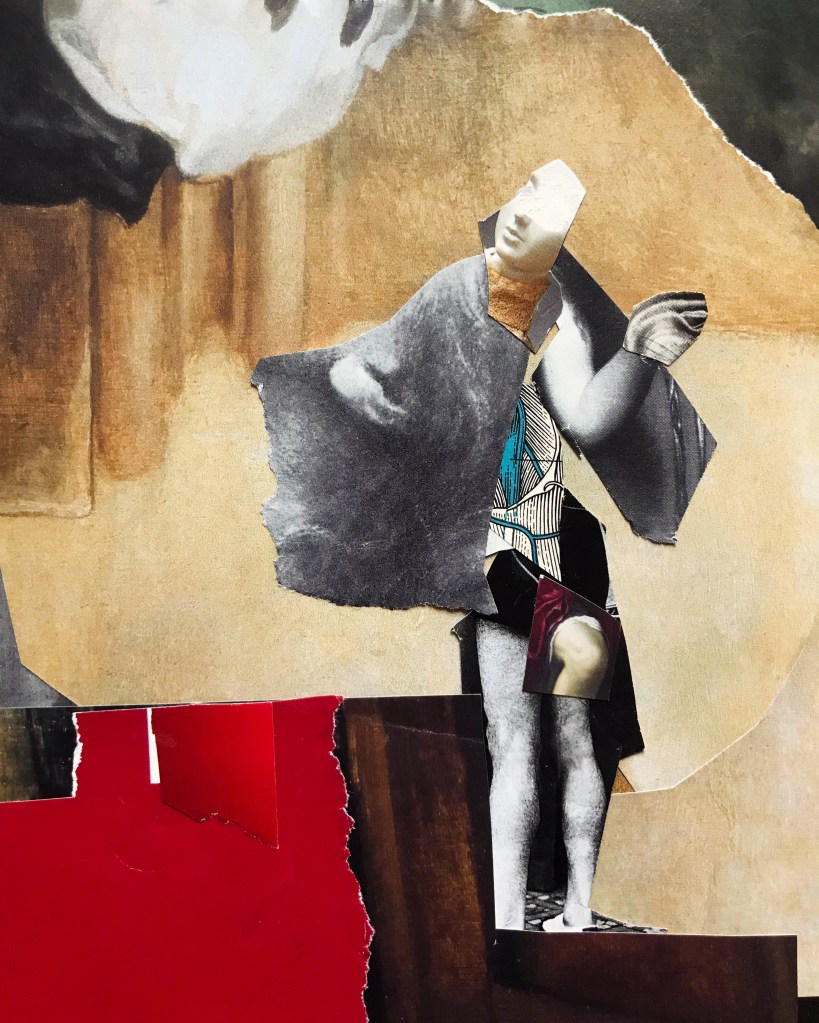
Mysteries of Life
by Kathy Bruce
Theo Fox is currently completing the fifth year of his doctoral research in literatures of disability at York’s English program. His work investigates chronic illness, trans identity, and marginalized autonomies, seeking to chronicle resistance through counternarratives of self-definition. In writing, he approaches the world through an ethics of crip materiality, centering the bodymind alongside questions of queer selfhood and institutional codification.
Kathy Bruce is a visual artist based in Argyll & Bute, Scotland, and Upstate New York.She is the recipient of numerous awards, including the Pollock-Krasner Foundation Fellowship, 2 Fulbright-Hayes scholar grants, and a Ford Foundation Grant. Her work has been exhibited in the UK,US, and internationally, including Senegal, Taiwan, Denmark, Peru, France, and Canada. She is a graduate of Yale University and the Pennsylvania Academy of the Fine Arts. Bruce is a contributor to various literary journals, including: Three Rooms Press, Lunch Ticket, The Vassar Review, Alchemy Literary Magazine, Open Minds Quarterly, Yale University School of Medicine’s The Perch, The New Southern Fugitives, Up the Staircase Quarterly, Ignatian Literary Magazine, The Variant Literature, Landlocked Literary Magazine, Rutgers University’s Rejoinder, The Brooklyn Review, Twyckenham Notes, The Porter House Review, Pushing Out the Boat, National Women’s History Museum, Minding Nature, The Howler Project, and The Camas Journal.


