
by Casey McConahay
“WHEN AM I GONNA LOSE YOU” – LOCAL NATIVES
It was during the pandemic—during the early weeks when everything felt uncertain—and when we sat on your porch together, you told me about the boxes you were disinfecting and about how your sister, who was worried about you, would be upset that we were meeting.
I probably stayed longer than I should have It was cold when I left you, and I hadn’t brought a jacket.
But I wanted to see you again. I knew that.
From the very start, I knew that.
“BALLAD OF CAROL LYNN” – WHISKEYTOWN
Work had kept you busy, you told me, so I brought beanbags and table tennis paddles, and we played games at the park by the river.
I hoped you’d ask me over afterward, but you didn’t. Not after the park games. Not after the night that fall when we took a screenprinting class. Later, after I mailed you a story I’d written, you told me that you were seeing someone else.
It was over, I thought—likely over. But I thought about you often—after dates with other women, when I drove through your city, during quiet moments when I felt the ache of loneliness.
It was you that I wanted to be with. Always you. You. Only you.
“ALINE” – CHRISTOPHE
I believed—for a time, I did—that we could be friends, like you’d suggested. I wanted to see The French Dispatch, which was on in Warsaw. Did you want to go with me? I asked you.
You wore a Third Man Records sweatshirt, and you asked about my nephew. I was tentative with you, but sometime before the movie started—when we talked through the previews; when you laughed and smiled and touched me across the armrests—I knew that friendship would be a fragile thing: that it would break in my hands though I cradled it.
“VENUS IN FURS” – THE VELVET UNDERGROUND
We could go bowling together, I told you. Or go ice skating. Or go to laser tag. You were excited about all of it. You said roller skating, maybe.
Instead, we watched a Velvet Underground documentary, and there was a moment that evening—late in that evening—when I picked lint from your hair, and you leaned close like you might kiss me.
You never talked about your boyfriend.
One night, when we had plans together, you had me meet you at your friend’s house. We had dinner. Played a card game. It had snowed days before, and late at night, when we left, we walked through the snow to your house, and when we sat in your dining room and read a book of Bob Dylan lyrics, I hoped you’d ask me to stay the night with you, but you were ready to go to bed, you said, and I said, I guess I’ll go home then.
I did anything you asked of me.
“I FOUGHT PIRANHAS” – THE WHITE STRIPES
In Portland last summer, a friend suggested that we could go see a concert. Jack White was in town, he told me.
Once, when I was visiting you, you showed me a drumstick you’d gotten at a Jack White concert. You’d seen him over fifty times, you told me.
On the night of the Portland concert, I drove north to Port Angeles, Washington. I went fly fishing in the morning. I went to the grave of Raymond Carver. I went to Aberdeen again and took my time driving back.
Sometimes, when I’m listening to the radio, I hear a song that makes me think of you. And I always change the station.
“MT. WASHINGTON” – LOCAL NATIVES
It had been a difficult year for you, you told me. Your break-up. Work. A longtime friend who wouldn’t talk to you. You cried and told me that you thought you were figuring it out, but you weren’t ready to start dating again. In November maybe, when things were slowing down at work—
We would sometimes meet for dinner though. I brought you carry-out because you were busy writing grants, and on the nights when I missed you—when you had work or ate with friends or watched your niece and your nephew—I don’t have to see you right now, I imagined telling you. I don’t have to see you right now.
“TOUCH ME I’M GOING TO SCREAM PT. 2 (LIVE)” – MY MORNING JACKET
You leaned into me on your loveseat, your heated blanket above our bodies. I took your hand—touched your palm, touched it gently.
Banshees was on your television, but you weren’t watching it. You were sleeping against me—or you were feigning sleep at least. You brought my hand against your breast then, and later, when the movie ended, I told you that your living room was beautiful. The stack of books in the room. Burning candles.
In your bed that night, I hardly slept—hardly tried to. None of this was guaranteed, I knew. Maybe there’d be a thousand nights beside you. Maybe it would feel routine in time—the air purifier humming in the background, the heat of our bodies beneath your blankets. Or maybe you’d wake in the morning, apologize, and say that no, you hadn’t wanted this.
If I could’ve—if I were able to—I’d have stayed in those moments. I’d live in those moments only—would play them over and over like a song you never tire of.
“GIRL FROM THE NORTH COUNTRY” – BOB DYLAN
Too late you told me that if you could do anything for your birthday, you’d take a trip to Chicago. You’d wanted to do something special, you said, but your friends, whom you hoped to celebrate with, were taking you to dinner—nothing else. You were disappointed about it, but because I knew it would make you happy, I gave you a gift that I’d gotten you, though it was days before your birthday.
I was always planning gifts for you. I wrote down songs you’d recommended. Songs you’d play when I’d visit. Someday, I thought, I’d write about you, and those songs would be a part of it. Like a mixtape, I imagined.
This was supposed to be a love story.
“I KNOW THE END” – PHOEBE BRIDGERS
Days before the basketball game, you had drinks with a friend. You texted me sometime that evening. Do you ever look at me and think I’m broken? you asked me.
I made a list for you later—listed all that I saw in you. And on the way to Indianapolis, I watched you cry when you read it. Watching you apply your makeup in the visor mirror, I wondered how I got to be so fortunate: how I got to have someone like you in my car, in my life.
But this is something I learned far too late—that while I was looking for reasons to love, you were looking for reasons not to.
“BLACK MAMBO” – GLASS ANIMALS
What you liked, you said, was feeling. Feeling was the important thing. What about the lyrics? I asked you.
You shook your head. Feeling, you insisted.
After the concert—at a bar that your friends liked—you told me you weren’t feeling well, and you wanted to go home.
Sometime the next morning—when it was dark in your bedroom—I felt your hand: felt you touch me. I was foggy from lack of sleep then, and when you reached for my body, when we were a tangle of bare limbs, I tried to find you in the darkness.
After it was over, you went away from the bedroom. When I came downstairs, I found you, but you wouldn’t talk to me.
I kissed you on the forehead.
Goodbye, I told you, but I didn’t mean forever.
“MAPS” – YEAH YEAH YEAHS
You couldn’t explain it, you told me. Chemistry was a word you used, and you said it like it meant something. You didn’t know what to do, you said. You said you hadn’t had time to think about it.
It was all that I could think about. I thought about it until I felt sick to my stomach, and at night, when I couldn’t sleep, I was thinking about it still.
I’d try to give you space, I said, but you were sand between my fingers.
Wait, is what I was trying to tell you.
I was asking you to stay.
“FAKE PLASTIC TREES” – RADIOHEAD
You told me about your niece and your nephew and your sister, who made you cry sometimes, and you told me about a friend, a Jehovah’s Witness, who wouldn’t bring you around his family. You told me about the mayor and his alcoholism and his wife sick with cancer, and you told me about your health problems and your dietary restrictions and the father you’d not had a relationship with. You told me about the mother who wasn’t kind to you and the hike you’d nearly died on, but you never told me what you felt for me, and when I was trying, again, to talk to you, you didn’t tell me anything.
You didn’t say—never said—that you loved me.
“LET’S BE STILL” – THE HEAD AND THE HEART
Love is a feeling of course, but love can also be a purpose. Love is a reason to wake in the morning, to look forward to what’s ahead, and when everything else is in disarray—your work, your family, your bank accounts, your plans—love can convince you that all of this will be fine somehow: that somehow love can make it fine.
When love like that is lost though—when the light that it gave you is removed from the world—
What I am trying to tell you, is that I feel your absence always.
“DON’T THINK TWICE, IT’S ALRIGHT” – BOB DYLAN
I’d written you a letter, but I didn’t want to mail it. I’d bring it over, I told you.
You had your niece and your nephew. We played a game with the children where they pretended they were animals, and I was animals also—first a crab; then a penguin—but when it was time for your niece’s yoga lesson, I picked up toys and markers and the pages of children’s coloring books, and I walked you to the driveway.
Days later, after you read the letter, you said you didn’t feel what I felt. I was hurt of course, but I’d expected it. Every moment that I’d spent with you—every, every moment—was spent afraid that you might leave me. And one day, of course, you did.
After you’d buckled them in their car seats, you drove by me with the children. You waved at me, and the children waved, and then you went—drove away.
I watched you drive in the other direction.
I watched you leave me behind—watched you go.
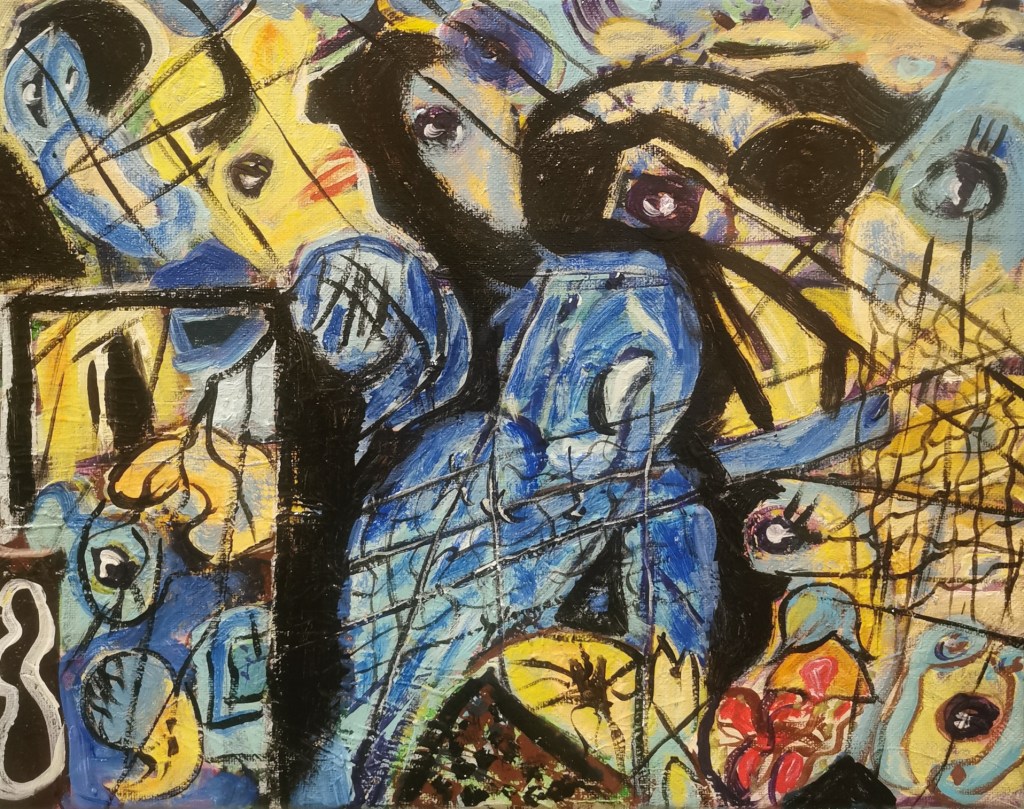
Psyche Acrylic
by JC Chen Henderson
Casey McConahay is a Pushcart Prize-nominated author whose work has appeared in December, Beloit Fiction, and Southern Humanities Review. He lives in northwest Ohio.
JC Chen Henderson publishes fiction, poetry, and visual art in literary reviews and poetry magazines. Her work appears in journals such as Fourteen Hills, Poetry East, Sunspot Literary Journal, Freshwater Review, The Pointed Circle, The Clackamas Review, and SLANT, to name a few. Henderson strives to express spirituality and sexuality in her work. She has sold hundreds of her paintings.


