
by Carl Boon
The pictures prove our parents were young, with neat clothes and unscarred skin. The pictures prove they did things: picnicked at sundown among yellow-studded Pennsylvania hills, stood in line on Friday afternoons at the First National Bank, paychecks in hand, and drove Pontiacs, their destinations sometimes unclear, their Amoco maps folded incorrectly. It matters to note they lived, often richly, without thoughts of us, under skies rendered dangerous by weather or war. Look—
my mother’s legs are crossed: she’s seated on a stool at the Woolworth’s counter awaiting her order of meatloaf and mashed potatoes. It’s winter, it’s Tuesday, the hopeful night of the New Year has passed, and outside, on Tuscarawas Avenue, the rain’s beginning to change to snow. An older man in glasses watches her, a woman in an apron wonders about inflation, and the children who belonged to that time are elsewhere: in elementary school classrooms listening to the Gettysburg Address, in innumerable cafeterias from Ohio to Hawaii pondering canned peaches and pork cutlets and potatoes sliced into strings. It’s 1968, and a social studies teacher in Iowa carries a new camera, a Christmas present, and look—
his name’s Carter and he’s taken a picture: the boys and girls have put down their milk and for a moment remain still for him. Some grin wildly, some sneer, some will stay home the week following, sick with the flu. Some of their brothers have already died in Vietnam and others will, their lifeless bodies roused by avid captains and frightened children whose rifles tremble in their hands. If you want to know America, the pictures will tell you everything: my father preparing to drive a Titleist at Brookside Country Club, the fourteenth, a long par four. His brown shirt features a penguin, his trousers conceal legs too thin to be his, and his hair must be bobbing in the intermittent wind. It’s August of 1971, they’ve been married two years, and I wasn’t there. I might’ve never been there at all; they might’ve gone on without me, without the knowledge that I am. Look—
you and I are here owing to odd collisions of space and time. He might’ve died in Vietnam. She might’ve slipped on that new-fallen snow on Tuscarawas Avenue, a cracked heel, a cracked rib, a Pontiac driven wildly by a man whose son just died in Vietnam. And then what? Being here’s nothing more than twists of will and circumstance, an evening when a game of bridge ended early, Nixon on TV, the neighbor’s wife having had one too many gin and tonics, a pan of roasted chicken placed back inside the oven. They were unhappy because the war would never end. They were happy because the cheese log and Triscuits had gone over well. There were limes and olives and occasionally deep and fiery conversations regarding jazz and journalism and the future of America. Look—
they’re all there in the picture. It must’ve been a holiday, Thanksgiving, button-down shirts, loud ties, long dresses. Beyond the picture, there are rooms nobody went to: rooms full of older pictures and rooms full of parkas and handbags and secret letters in certain pockets folded down to squares so small no one could’ve seen them. And in the handbags are bottles of perfume and Wintergreen gum and checkbooks and abbreviated Christmas lists: sw. and TU and things we can’t understand because we weren’t there. Then coffee, then pie, then a man saying how the snow had fallen—“it’s come early this year”—and the exercise of wiping windshields and saying goodbye and turkey in tin foil “for sandwiches later” and all the temporary love that exists in a place and 1972 would be better “because it had to.” And look—
please look beyond these things I give you: heartbreaking Wednesdays and pleasure deferred, worms in the flour, milk gone rancid, and all those mosquitoes in the summer of 1972 while Nixon drank Macallans and gazed cross-eyed at his billiards table in a shadowy West Wing room. It was up to him. It would always be up to him. The sweat-stained gray suit, the comb dropped in the hallway, the lies that eventually became everyone’s lies. Chicago redux and the poets were dead. There must be a picture somewhere, but they knew—they knew over ginger ale and Miller beer and strange bean casseroles straight from the Ladies Home Journal—that things would never be the same, could never be the same. They knew Sinclair Lewis was finally right and their trajectories would escape them. They knew it when Cronkite spoke of Watergate while they waited in line for gas. They knew it when the mullahs of Iran gathered up their rifles. They knew it when the dumb actor spoke in long-decimated Detroit of a country that never did belong to them. They knew, and look—
it takes a long time to know. We were babies then, we were toddlers in pajamas with feet while they dissected and bisected and eventually gave into games of chance—poker and Japanese cars and the mall and it hardly mattered when the hockey boys beat the Russians. It was over. They still had hamburgers to eat and movies to watch and PTA meetings and bowling leagues, but it was over. And on the Fourth of July in 1981—when you and I were seven—the fireworks boomed but the chocolate cake didn’t quite taste the same.
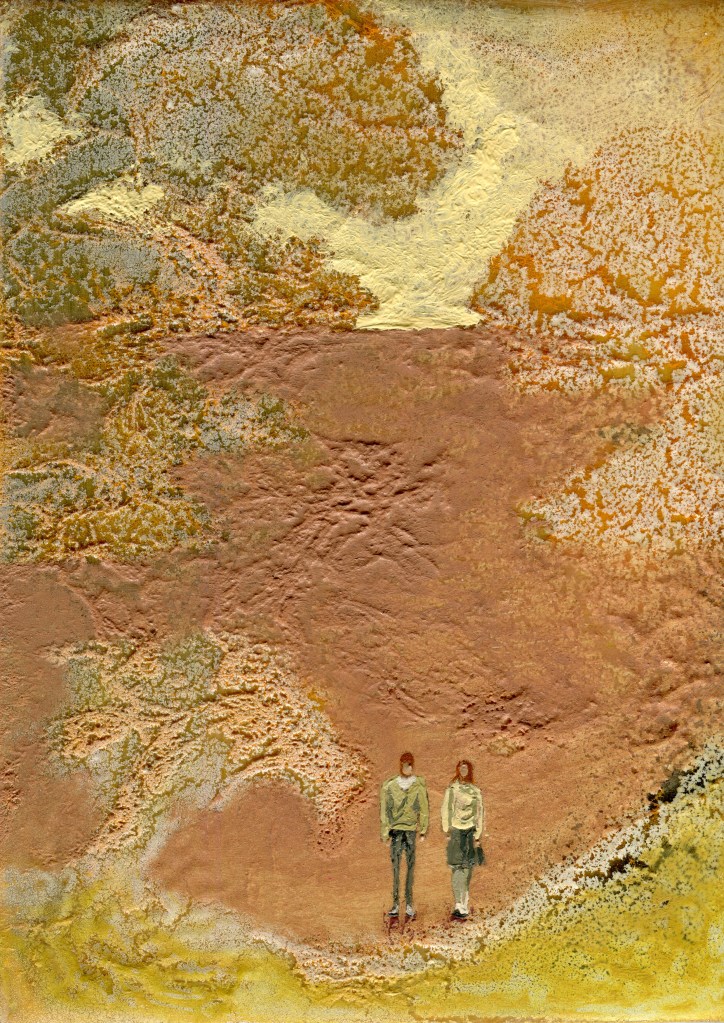
Honey Lung
by Jack Dunnett
Carl Boon is the author of the full-length collection Places & Names: Poems (The Nasiona Press, 2019). His writing has appeared in many journals and magazines, including Prairie Schooner, Posit, and Washington Square Review. He received his PhD in twentieth-century American literature from Ohio University in 2007 and currently lives in Izmir, Turkey.
Jack Dunnett is a mixed media painter who grew up in the Highlands of Scotland. He obtained his Bachelor of Arts in Painting from Gray’s School of Art in 2017. He currently lives and works in Glasgow.


