
by Richard Weems
When the dog bites into my father’s forearm, I am tempted for a moment to intercede. After all, there have to be more ideal points of attack than that tough strip of muscle. My research suggested the belly was the most vulnerable and scrumptious entryway, but, in the end, I defer to my retired fighter dog’s expertise. Plus, I’ve trussed my father’s arms to his sides, so perhaps the bitch realizes she can take her time. My father wriggles defensively, but the trough I dug into the dirt floor of this abandoned milk barn is deep enough to keep him from slinking away.
I jiggle my nose to prevent a sneeze. The air is dry, musty. My father attempts a scream for help, but the gag muddles the effort. There are no living persons within miles of this barn, as far as I’ve seen, so perhaps the gag is overkill (so to speak). But, I have no intention of being anything short of a lethal force in my father’s life in recompense for his effect on mine.
The dog has proven a reliable companion: protective, responsive to command, always close to heel. Qualities endemic to master/canine relationships, according to my research. Her name is Wisky. “My father” being my sole attributive for my father and none of the available variations (Pop, Old Man, Progenitor, The Cause, Patient Zero) should connote the quality of our relationship. My father instilled in me nothing more than the desire to sic a dog with strong jaws on him.
In my adulthood, with no romantic relationships nor even the prospect thereof, the same to be said of friendships save nods of acknowledgement and brief exchanges regarding the weather with colleagues at the Kraft cheese factory, I came to the conclusion that my father was to blame. I do not know my precise age, for reasons that will be revealed in time, but my research suggested such self-audits often hit when one turns forty. My initial inclination was that I should locate my father and take out my newly realized abandonment issues in knockdown, dragout fashion, such as that depicted in the Johnny Cash song “A Boy Named Sue,” our fisticuffs culminating in understanding (maybe love?).
But how to find a man you’ve never met? Though Johnny Cash recognizes his father from a scar and his “evil eye,” whether that be lazy, clouded or askance, I had no photographic evidence from my childhood to guide me should my father happen into my path. And my house is remote enough that I rarely encounter passersby. Mom rarely spoke to me, so I didn’t waste time during our brief exchanges to discuss him. She kept mostly to her room. The only times she ever came out, she exited the house completely. When she returned, sometimes days later, she’d drop a bag filled with powdered milk, corn flakes, and cans of meat by my hay mattress. In her room she kept the sole TV, so my only means of entertainment, if not yanking up weeds, worms and grass outside, were a row of records stored inside a sagging milk crate. The record player had but one speaker with a frayed wire, its volume marginal at best. To hear anything, I had to pillow my head against it. Thus, I often played with the records in other ways: stacking them, reading aloud lyrics in different voices, guessing who played what in the band photos. Vocalists often seemed self-important; bassists or keyboardists bored with their poses. The aforementioned Johnny Cash looked tired, worn down with life.
Every now and then, Mom confirmed our relation to each other by opening her bedroom door and bidding me enter: “Son.” That door may have always been unlocked, but I never dared it without her permission. She’d pat a corner of her mattress where I could sit a short while. I kept my gaze on the TV, where audiences laughed or applauded indiscriminately. Mom would finger some hair back behind my ear, an act I’d come to yearn for, until tears weighed down her lashes. Then she’d tap me on the temple and mutter, “Shoo, now.” The more still I sat, the longer I could stave off her shoo.
When Mom fingered my hair behind my ear, did she hope to see my father? Or did reminding her of him spur her to shoo me away? When I found him, I saw that my father did indeed keep his greasy hair swept behind his ears.
In time, someone came to the house to proclaim my legal obligation to go to school, a rotund woman in a crisp, brown suit that should have crunched like corn flakes when she walked. I obeyed, though my schooling was more a matter of taking up time and space at the back of a classroom and staring at words, letters, and numbers in nonsensical configurations on the board. If anything, I learned my name: Skelton Splodge. I also learned that my name incited boys on the schoolyard to hurl tightly packed balls of mud at me. The father in Johnny Cash’s song claimed to have named his boy Sue to toughen him up, so I presumed my naming was rooted in similar reasoning. I stood fast and willed back my tears when the boys graduated from mud to gravel.
And one day, when I came home toting the books I never read but was ordered to carry back and forth, the woman in the crispy outfit blocked my way. She informed me Mom had died, her remains already carted away. “Sorry,” she said, and she waddled back to her car. Mom’s bedroom door stood open, her mattress cleared of sheets. How long I had lived with a corpse in that cabin, I’ll never know. I piled my school books into the semblance of a chair.
In a few weeks, cash from Mom’s estate was left taped to the front door. I first decided to take my inheritance on the road, but made it only three counties over before it ran dry. But since I had chanced upon a lost driver’s license, I brought it to the local Kraft factory, which was always hiring. Skelton Splodge no more. I transitioned into a functional adult, one who could boast of steady employment, an education supplemented by the local library, and the submission of taxes. Until my self-audit revealed the vacuous abyss my father had left me in. I figured fisticuffs alone weren’t enough to settle my grievances.
I trust my resolve towards revenge is now explained.
Sad to note that my first attempt to Google ‘Splodge in my area’ revealed Presley Splodge: old enough, current residence one county over. I had booked myself an hour of computer time at the library, and I already had my target (the hair swept behind the ears, remember?). So I researched effective methods of trussing (how informative, this internet). I researched painful methods of death, which led me to news reports of dog attacks and the conclusion that I needed to get myself a dog of useful disposition.
Wisky is a doberman, strong jaws a genomic attribute, so her bite is no small matter. Dogfighters are as easily located as plumbers or roofers in my environs. The man even wore a shirt advertising his website, www. GetYoselfAFightingDog.com. Wisky had no name at the time—this dogfighter had no sympathy for his animals, only goals. Her bite command was also his favorite drink, to make it easy to remember I imagine, and thus became a good enough name to bestow upon her. Unfortunately, I was too impressed by her going to town on the nice, thick femur I had brought to test her with to spellcheck the bill of sale. This dogfighter was as heartless and unwashed as any man I had ever stood close to: stained of teeth and clothes, his hair brittle, and a haze of liquor so thick the air around him sweltered. He lorded over Wisky by way of a collar full of nails and a glass-encrusted leather belt, both of which I accepted from him, but only to expedite our transaction.
I may arrange one day for Wisky to have a shot at her former owner. After all, acquiring her loyalty was easy-peasy, as they say: meat, treats, scratchies on the scar tissue that stood in place of ears, and a standard choke chain. She could no doubt smell that we had both been mistreated.
As my father touted his favorite watering hole in his Facebook profile, surveillance and abduction were also painfully easy. His habit was to stagger back to his truck alone in the dark, and by then I had gotten my trussing skills down to an art. He didn’t make much of a fuss in the bed of my truck, as though he figured himself either pranked or resolved that his day had come. In my aimless travels to pass friendless free time, I had come across this abandoned milk barn accessible only by way of a tractor trail which branched from a dirt road on a barely identifiable turnoff from a county highway.
After dragging my father into the milk barn by the heels of his work boots and depositing him in the trough, I stood over him a moment, debating whether to recount his crimes and my identity. Odd to say this moment was the only one I hadn’t pre-planned. I looked down upon him, composing a speech like the one ascribed here, while he glared with bloodshot eyes as though at a cold caller unable to get to the point.
In the end, I decided against explanation. So I unhooked Wisky, pointed and hissed, “Whiskey!” and she went to work. His expression soon changed once Wisky took to his forearm.
Thus, we return to the opening.
Wisky has dug deep into my father’s arm and extracted a tough-chewing strip, but either due to her age or the starvation I subjected her to for three days before this endeavor (carrying out my mission superseded my empathy), she shows little interest in targeting more lethal portions. Perhaps she is wizened enough to know that killing him too quickly will spoil him as a food source. Wisky is nine, old for a fighting dog, I was told. Yet the dog fighter had put off exterminating her, for her last fight had been months before I bought her. When he handed over the bill of sale, he insinuated with a spit of tobacco, pickerel grin, and a mumbled, “Good,” that he had run out of reasons not to put down the old girl.
This memory proves frustrating now, as it problematizes my plan to one day sic Wisky on him as well. I doubt Wisky has any capacity to consider vengeance, and that might be to her advantage. My resolve starts to accede towards questions. How will murdering my father reverse the damage already done to my psychological development (or lack thereof)? And, will killing him only etch him further into my brain and doom me to unbidden flashbacks? Because Wisky’s instilled technique is to attack sans growl or snarl, I can hear my father whimper.
The conclusion is obvious: I have failed to achieve any pleasure from my supposedly justified revenge.
I pull Wisky to me, remove her choke chain, and shoo her from the milk barn. She is reluctant at first, loyal to a fault, and I must throw a roof shingle at her before she lumbers off into the adjacent field and her emancipation.
And now to offer my father reprieve.
My research suggested that forgiveness was the only true reconcilement one could have with an absent father. Obviously, I rejected that proposition at the time, and though I once considered the reconcilement at the end of the Johnny Cash tune laughable, I now regret not venturing towards the warm fires of Camp Forgiveness.
I push my heavily mauled but still breathing father to his side and loosen his binds. His eyes show distrust. Well earned, I guess. He watches me the best he can, his arm pretty thoroughly chewed, but serviceable. I give him enough slack so he can free himself, and I exit the barn, my defeat total and complete. I fire up my truck, let it rumble into activity as is its wont, and take another look at my father, who favors his torn arm as he struggles from the trough onto the floor proper. He pulls inefficiently at the duct tape wrapped over his mouth.
He starts to lift his chin, to raise his gaze in my direction. The thought of meeting his eyes now ignites a yank of terror through my viscera. If I did clue him in to our relation, I am too ashamed of my failure to face him now. I crank the truck into gear and tear down the tractor trail to the dirt road. Once back on the county road, I push the accelerator for all its worth and keep my seatbelt off.
In this hilly territory in the Adirondacks region, I ponder a crash resulting in a ball of flame, but I am not deserving of a quick and painless end. In fact, being trapped in the tangled wreck of my Ford Jalopy in a ditch, sustaining myself on drops of morning dew in false hope of being discovered seems more fitting. I have chosen isolation, and I must make my bed there. Even my acts of compassion were no doubt misguided—Wisky, free but lacking any experiential training for survival except to kill and maim at the behest of her alpha, is most likely going to meet a miserable end in the wild or get scooped up and deposited in some pound, maybe to fall into the hands of another dogfighter. And my father, grievously wounded and without mode of transport, may bleed out before he can reach help.
Wherever my body is found—be it decomposed in a heap off a lonely road, or of inhalation if I do manage to make it home and set fire to my apartment, or nosed by neighbors if I decide to off myself in some classic wrist-slitting—it will evidence nothing more than the forgettable death of a lonely man. May it be disposed of in a way most expedient to hirees who won’t bother taking time to catalog personal effects that no one will ever collect. Like meat packers hauling product, may these hirees load their van and amble on to their destination with no more fanfare than any other work day brings. If they get along, may they find mutually agreeable music on the radio, share a cigarette or bottle, talk wise about the shortcomings of their job or supervisor, and/or rate the quality of any desirable personages they pass. Even if they don’t get along, may they still acknowledge each other’s existence, make functional commentary, and not blame their lack of camaraderie on their childhoods. Regardless of their relationship, may they say “Yup” to each other often, or, “I know what you mean,” little affirmations between humans who give at least a mild shit about one another.
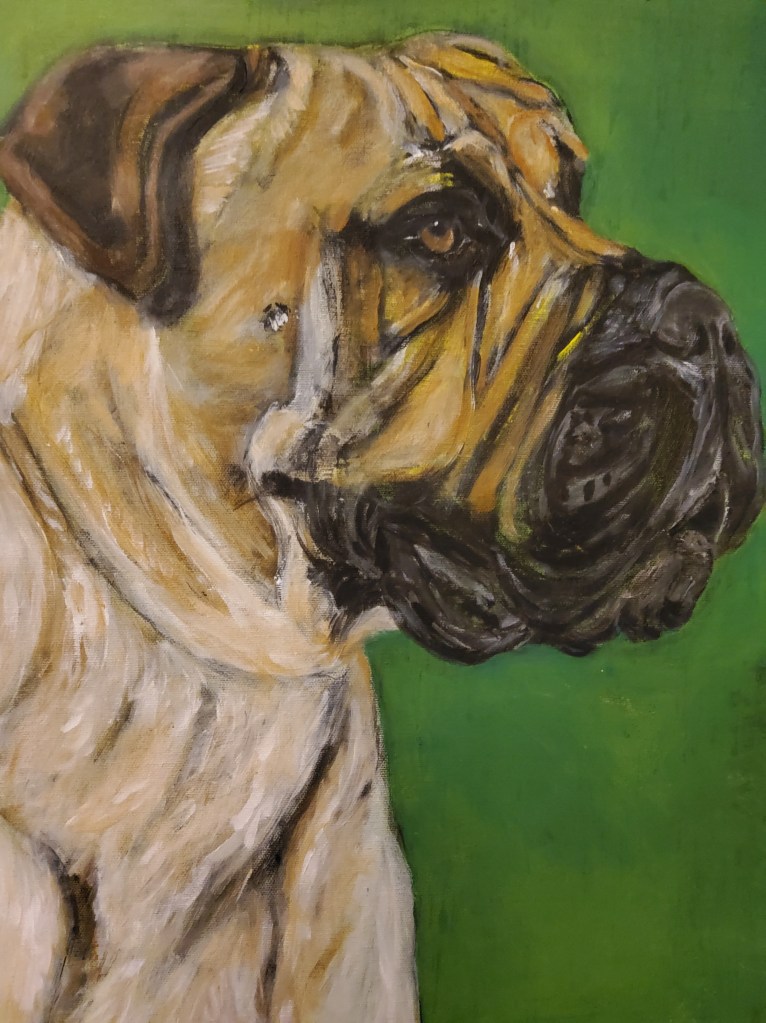
Mastiff
by Pia Quintano
Richard Weems is the author of three short fiction collections: Anything He Wants (finalist for the Eric Hoffer Book Prize), Stark Raving Blue, and From Now On, You’re Back. Recent appearances include prose.onl, North American Review, Quibble, New World Writing, On the Run, and Flash Fiction Magazine. He is a recent retiree from the teaching profession.
Pia Quintano is an NYC-based writer/artist who especially likes to work with animals. Her paintings were sold at the Frank J. Miele Contemporary American Folk Art Gallery in NYC until it closed.

 Ignatian Literary Magazine