
by Aamena Lalji
We eat popsicles in front of the television, sucking on them ‘til our cheeks are sore, peeling like wallpaper. Red juice drips down both our chins. You break the stick in half and tuck the pieces beneath your top lip, over your front teeth, smile that gummy smile at me. “I’m a walrus,” you say, and the pink half of the popsicle stick comes loose and falls to the ground. “See?”
I wonder how long you will stay like this, with me, you a walrus and I, your floating rock. How long until the wave washes over you, peeling your flippers from my sediment;
I cannot be your foothold forever. You are my son, and I am only halfway your mother.
In the kitchen, we eat mac and cheese from the box, and orange covers the red on our tongues. You whine when it is time to go to bed, clutching my fist like there is gold beneath my fingernails. But there isn’t, only cheese powder I can still taste in my mouth, clinging to the roof of it like asbestos. I’ve never liked the fake stuff, but you do and that’s all that matters.
“I’m not tired,” you protest, voice cracking in the middle and reminding me you are still a boy. “I’m a shark. Sharks don’t sleep.”
“Not true,” I say. “They do sleep, just with their eyes open. And besides, I thought you were a walrus.”
You stick your tongue out, the color of the sun. “I’m both!”. Run away to your room before I can tell you that it’s impolite to stick our tongues out at people, especially our elders.
A mom would’ve been able to tell you that, I think. A mom would’ve fed you something other than Kraft for dinner, popsicles in front of the television. A mom would’ve told you it is possible to be both a shark and a walrus. How deeply I am reminded, every day, that I am not your mom.
It is late into the night before I hear your snores from the wall connecting your room to mine. Night has settled over us like a cool blanket, the air thin and slippery, like the skin of an eel. For a moment, I am reminded of the place where I first met you, knew you were mine.
The aquarium was crowded; too many people, even for me, even though I worked around them every day. You were in your stroller, black with a bright blue handle, a pacifier hanging from a string around your neck. Nearby, a couple took pictures in front of the orca tank. The woman had hair the same color as yours.
I watched you for a minute, noticed the way your tiny hand closed around the crinkly seahorse hanging over your head, how your eyes skittered past the spaces between your fingers like you weren’t sure where to look. When you yawned, there was a tooth poking out between the gums at the base of your mouth, small and pearly white. I had the strange urge to dip my fingers through the shell of your lips and pluck it loose, tuck it into the pocket of my uniform, and keep it, just because.
The couple walked a few steps further, palms pressed against the glass of the exhibit and backs turned away from you. They laughed when one of the orcas caught the tail of a fish between its teeth, and I wanted to scream at them ‘til my lips bled. Look at him. The words pushed against my mouth like a soap bubble, shiny and taut. Look at your son.
Look at how my thighs press together to hide the blood between them, how my stomach hangs heavy with the weight of something I never had, never will have. Can you see the sadness tucked away in the crevices of my smile?
They couldn’t, of course. You couldn’t, either, with your small hands and small teeth and hair the same color as your mother’s, which also happened to be the same color as mine. You met my eyes and gurgled, spit falling from the corner of your mouth in a thin string.
You couldn’t, but that didn’t mean you wouldn’t be able to, someday.
I learned your name over the two months that followed. Oliver. Ollie for short. Your parents brought you to the aquarium every Friday; I guess it was the only date they could afford. Cheap tickets and free food if you could sneak it past Jem, who owned the gift shop and was often too high to notice the bulges in people’s pockets. I’d stolen more Dippin’ Dots from Jem’s cooler than I’d care to admit—my favorite was the cookies and cream.
I’d watch them from my spot near the petting tank; they loved to touch the dolphins. Loved to touch anything, really—I’d follow them sometimes with glass cleaner and a rag, cleaning up the fingerprints they left on every exhibit they passed. Strangely, though, you seemed like their least favorite thing to touch. I never saw either of your parents take you out of your stroller, except your father, once, to check if his phone had fallen behind the cushion.
One day, they asked me to watch over you while they used the restroom.
“Both of you?” I’d said, looking between them curiously. “I mean, sure, I don’t mind, but maybe you guys can take turns. If my boss catches me holding your baby, I’ll get written up, and—”
“Please?” Your mother blinked her eyes at me, slow-like, blonde lashes sweeping the tops of her cheeks. This close, I noticed how young she looked, probably no older than twenty. Pink lipstick stained her two front teeth. “He’s sleeping, and we really have to go. It’ll only take a second.”
“Five minutes, tops,” your father, next to her, coughed, lips twisting up into a smirk. My eyes trailed down to his hand, resting low on your mother’s hip, fingers plucking at the waistband of her blue jeans. His eyes were black and bottomless, and I swallowed even though my throat was dry.
“Um, sure.” I don’t know what possessed me to agree, but by the time I opened my mouth to change my mind your mother was pushing your sleeping body into my arms, practically shoving you, sharp nails scraping the skin above my elbow. Then the two of them disappeared into the bathroom closest to the stingrays, the only one not separated into stalls. I could hear their laughter in the seconds before the door shut, swirling past my ears and making me drunk with the fullness of it. For a moment I found myself aching to be that young again, that desperate to be touched. They didn’t deserve you, and I knew it as I pressed you nearer to my chest, bounced you a bit in my arms like I’d seen mothers do with their babies in the movies. Not that you were mine. You weren’t, of course.
“Hi, Ollie,” I whispered. The words tumbled out of me with the cadence of a lullaby, and my breath made your eyelids flutter. “You’re so handsome.”
And you were. My sweet boy. I never knew a person could be so soft.
I trailed my finger down the slope of your nose, ran it through the strands of your hair, shiny and golden like corn silk. Would my baby have looked like this, I wondered? Maybe, maybe not. I didn’t even know if it was a boy. All I remembered was blood down my legs, on the bathroom tile, a curdle of red in the pit of the toilet. Slimy and cold, like wet spaghetti.
You shuffled in my arms, then, sighed out through your nostrils like a sleeping cat. I could have listened to that sound all day, I thought, and would have, if you were mine.
Could you be mine?
Your parents probably wouldn’t notice, and they almost definitely wouldn’t care. Your mother had practically given you to me, pushed you toward me like a basket of dirty laundry, a bundle of clothing that no longer fit. I’d be doing them a favor, really, doing you a favor—you deserved someone who would love you more than themselves. Someone who found you more interesting than a killer whale.
So I took you. And Ollie, my love, I don’t regret it.
When morning comes, you wake me as you always do, fingers pinching my cheeks and shaping my mouth into an ‘O.’ “Mama,” you say, shaking me, “Mama, wake up. I want waffles.”
“What kind of waffles, baby?” I ask through what feels like a mouthful of sand. Blueberry, you will say, as you do every morning. I want blueberry. “I’ll make you any kind of waffles you want.”
“Blueberry,” you say, and I bite back my smile. “I want blueberry.”
I think I was born to be a mother.
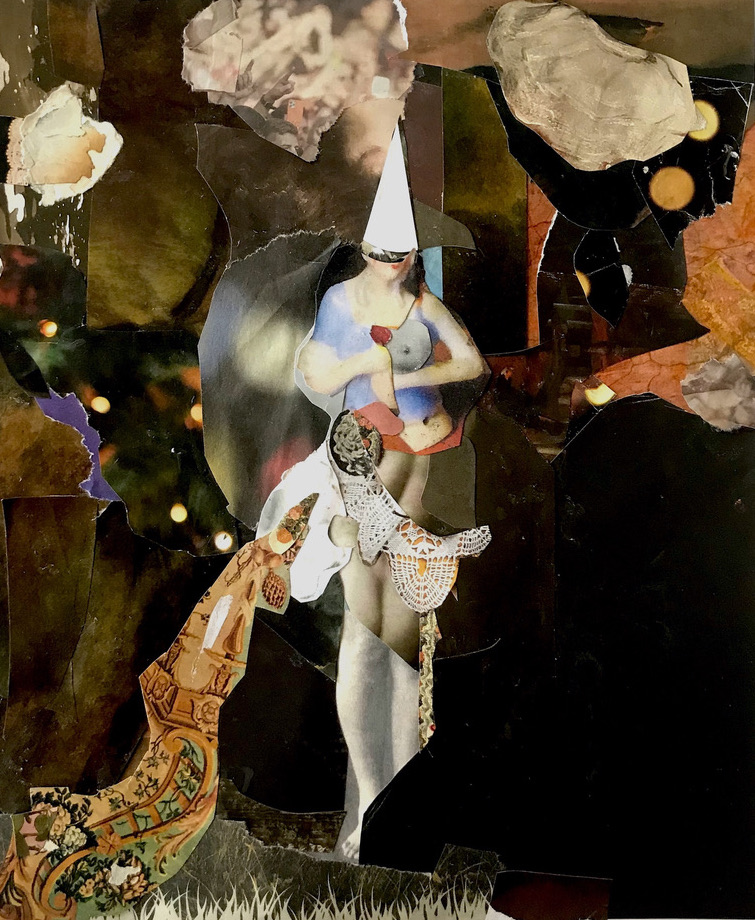
Contemplating the Nature
by Kathy Bruce
Aamena Lalji is a sophomore undergraduate student at the University of Central Florida. Although never previously published, she has been writing fiction and poetry since she was old enough to read it. She is currently studying English, Technical Communication, and Writing and Rhetoric.
Kathy Bruce is a visual artist based in Upstate New York and Scotland. Her work explores archetypal female and mythological forms within the context of poetry, literature and the natural environment. Ms. Bruce is the recipient of numerous grants and awards including a Pollock-Krasner Foundation Fellowship, Pennsylvania Council on the Arts Individual Artist Grant, 2 Fulbright-Hayes scholar grants to Peru, and a Ford Foundation Grant. She has exhibited her work in the UK, US, and internationally, including Senegal, Taiwan, Denmark, Peru, France, and Canada. She is a regular contributor to various literary journals, some of which include Three Rooms Press, The Vassar Review, Alchemy Literary Magazine, Open Minds Quarterly Journal, The Perch Yale University School of Medicine, The New Southern Fugitives, Up the Staircase Quarterly, Ignatian Literary Magazine, The Variant Literature, Landlocked Literary Magazine, The Rejoiner Rutgers University, The Brooklyn Review, Twyckenham Notes, The Porter House Review, Pushing Out the Boat, National Women’s History Museum, and Minding Nature.

 Ignatian Literary Magazine