
by Sura K. Hassan
I
“Run, run for the Sun.”
One of the shortcomings of growing up in the dry, scorching, crumbling desert city that is Karachi was the inability to escape from the ever-present, nauseatingly-bright sun. My poor, dear mother, maternal aunt, and even grandmothers all tried to do something about the permanent tan that became my complexion. No amount of sunscreen, Multani mitti,[1] or aloe vera ka gel[2] could prevent my skin from adopting a distinctly bronze hue. In our culture—and by that, I mean my immigrant family exclusively—dark skin means that you’ve struggled a lot and ventured out in the sun too much.
My maternal grandpappa, my Nana,[3] was one of the darkest blue-eyed people I’d ever met. His skin told the tale of a fallen empire: a dynasty that was over five hundred years old that began in a cave outside Mecca, migrated to the Persian straits, warred through India, and finally settled on the banks of the Hoogli River. My grandfather had witnessed the end of our family’s rich history, the birth of Pakistan and India, the struggle to keep princely titles in a changing world where monarchy was the exception and not the rule, and finally, an exile that drove him, a titled prince in his youth, to arrive on the shores of Karachi with nothing but the clothes on his back and half a dozen mouths to feed.
Nana never really cared about the colour politics in our family. Instead, he chose to make light of the situation, overlooking the ridiculous need to shelter daughters from the sun. So, when I started school and my father suggested that we get a driver, Nana was quick to volunteer. He’d make me walk home, a stark comparison to my father’s approach which consisted of always, always driving somewhere, even if it was a two-minute journey.
Nana believed that one must be prepared to live all kinds of lives—something that did not make sense to my four-year-old self. Instead, I’d tell him that Mummy didn’t want me to get a tan. Nana would grin at that, stating that I ought to be more concerned about getting heatstroke. So, when the sun burned too much and it made my sensitive skin twitch, he’d hold my tiny little hands and remark, “run, run for the sun!” and I’d giggle at the juxtaposition of incorrect English and the distinctly aristocratic accent as we both crossed the main road, turned right once, twice, and then finally turned left before arriving at my grandparents’ house.
[1]Multani mitti: literally means sand from Multan, a city in Pakistan. I don’t think they’re actually letting us rub sand on our faces; I think it’s just for a formula of a powder face mask developed in Multan. At least, that’s what I hope it is.
[2]Aloe vera ka gel: Aloe vera is a plant whose leaves are cut in half to reveal a gel-like liquid. It’s considered great for soothing the skin and fighting acne.
[3]Nana: maternal grandfather.
II
“Yeh tumhara first class, yeh hi tumhara last class.”
My great-great-great-great-grandfather, several times over (honestly, I have no idea how far back he goes), was the last Nawab of Bengal, Bihar and Orissa before the British invaders took his titles away and made him the Nawab of Murshidabad. In my family this particular bit of history is very, very humiliating. Nana, on the other hand, found it to be completely justified. After all, the last Nawab of Bengal, Bihar and Orissa was an idiot, as he’d often tell me. So stupid was he, he recounted, that he failed the equivalent of middle school not once but four times.
My Nana’s great-great-great-grandfather (also several times over) was his Persian tutor. One day, he grew so frustrated with the young prince that he flipped over the study table and yelled at him, “Yeh tumhara first class, yeh hi tumhara last class!”[4]
And so was born the famous family saying, a kahawat,[5] as we call it.
When I received a ninety-two percent in first grade, Nana looked over the report card, stopped at Urdu where I received a B+, and grinned. “Yeh tumhara first class, yeh hi tumhara last class.” After that, every time I excelled at something, Nana would say that and launch into the story of our ancestor who was so bad at school that he’d given up our empire to the invaders who’d once had to obtain a licence to trade in Bengal.
[4]Yeh tumhara first class, yeh hi tumhara last class: This is your first class; this will be your last class.[5]Kahawat: saying.
III
“Choti ‘Ya’ walon sey doori barkarar rakhiye.”
One of the most tragic incidents in our family, which is also surprisingly common, is the breaking of an engagement. So, when the daughter of a family friend broke her engagement to a man whose ethnicity ended with a choti ya[6] in Urdu, Nana had a very interesting take on it.
As the girl’s mother sat with Mummy, Khala Bi,[7] and Nunna[8] in the formal sitting room, detailing the circumstances of the situation—how the man changed completely after the engagement, how he refused to let her go out of the house (even though she still lived with her parents), how he wanted her to wear a burka[9] and didn’t want her to talk to any man, even her elder brother in Canada—Nana popped his head through the sliding door and remarked, “Choti ‘Ya’ walon sey doori rakhna behtar hai.”[10]
My sisters and I, who were sitting on the other side of the room pretending to do our homework, looked up, alarmed at the statement. “But that’s everyone!” we exclaimed, causing Khala Bi to glare at us.
“Aye, go to your room!” she scolded us, and we scrambled out, but not before taking a detour to Nana’s bedroom.
“Everyone’s a choti ya,” my youngest sister said to Nana the moment he entered.
Our grandfather smiled. “Really?”
“Yes, Pakistani, Irani, Hindustani.” She began to list all the ethnicities and nationalities she could think of.
“Kashmiri, Punjabi, Sindhi,” my other sister added. Nana shook his head.
“What about Angraiz?”[11] he asked, mischievously.
“Mummy would disown us,” I told him. He raised his brows.
“Are you sure?”
[6]choti ya: a letter in the Urdu alphabet. It looks like this: ې
[7]Khala Bi: maternal aunt.
[8]Nunna: maternal grandmother.
[9]Burka: a veiled piece of clothing meant to cover a woman from top to bottom, showing only her face.
[10]Choti ‘Ya’ walon sey doori rakhna behtar hai: It’s better to stay away from people with choti ya.
[11]Angraiz: foreigner; usually used to describe white people.
IV
“Murshidabadi bara fassaadi.”
In 2014 the Indian government reinstated the title of Nawab of Murshidabad to a relative so far down the line of succession that it baffled many family members. All those originally born during the time of the Nizamat[12] called my grandfather for his opinion.
Nana shook his head at the matter and retorted, “Kahan gaya Murshidabad, kahan gaya Nizamat,”[13] before hanging up the phone. My sisters and I were deep into our education of Pakistan Studies and thus, heavily invested in this news.
“So, who does the title belong to?” we inquired.
“The title belongs to you, your father, his brother, all of his paternal cousins—including our family—and half a dozen people in London and Maryland,” Nana said, “too much time has passed by, and the title’s meaningless.”
“What about you?”
“I was a prince, not a Nawab,” he informed us. “What matters is the Nizamat, and it belongs to the Indian government.”
“Why don’t we take it back?”
“It’s too expensive to maintain,” he shrugged, “and there are too many claimants who would have your head for it.”
“But it’s ours.”
“And the Indian government is taking care of it better than any of us could. If it were up to the Nawabs, they would’ve sold it bit by bit to the highest bidder.”
We stared at our grandfather in disbelief and perhaps, for the first time, realised that there was a hidden history we weren’t told about. Later, in private, I would implore him to tell me more, and he’d resist because you don’t talk ill of the dead.
But when my paternal grandmother gave our ancestral jewellery to her eldest daughter’s daughter, Nana launched into a rare outburst about the family, double standards, and the internalised misogyny the women in our family thrived on. We listened intently until the very end, and Nana, looking down at the three of us from his perch on the sitting room sofa, sighed in defeat.“Always remember one thing about this family,” he revealed, “Murshidabadi bara fassaadi.”[14]
[12]Nizamat: literally means organisation. In my family, it refers to the literal grounds of our ancestral stronghold and the royal establishment.
[13]Kahan gaya Murshidabad, kahan gaya Nizamat: Where did Murshidabad go? Where did the Nizamat go?
[14]Murshidabadi bara fassaadi: Murshidabadis are big mischief-makers.
V
“Inn aankhoon ney kiya kiya deykha hai.”
Imran Khan’s rise in Pakistani politics and the nation’s trust in his incorruptibility worried Nana a lot. He couldn’t bring himself to believe that someone could fix a country after so many years.
When the older of my two younger sisters pointed out that he was better than the establishment, Nana would shake his head and say that he’d seen many charismatic leaders enter politics with promises of change. In the end, they’d just lined their own pockets. Of course, she would argue with him. Nana took it well and at the end of an impassioned speech, he would shake his head and say, “Inn aankhoon ney kiya kiya deykha hai.”[15]
[15]Inn aankhoon ney kiya kiya deykha hai: What have these eyes seen.
VI
“Aata hai yaad hum ko guzra howa zamaana.”
Nana had always been extremely proud of my sisters and me. He was also extremely proud of our father for allowing us to study. When I got admitted into the Karachi Grammar School for O Levels, he would sit with me for hours, recounting the days he spent in school with my Dada’s[16] elder brother in Murshidabad.
The Hazaraduari’s gardens are so big that four football matches would happen at the same time. Nana’s team always won the match, partly because the Nawab Bahadur of the time’s son was on his team, but Hasnain Dada was a great football player too—he’d counter quickly.
That never stopped us from giggling away as he recounted one story after another, detailing how they’d win a match, bunk school to go to Calcutta and watch English films, and how once his future father-in-law caught them and reported him to the Nawab Bahadur, who looked at him and sighed, “Panna sahib, aap alag hain.”[17]
The statement had a profound effect on Nana, who would then take his studies seriously and decided at that very moment that he would go into filmmaking. “Understand what it is you want to do with your life,” he’d advise me, “and then pursue it relentlessly. Even if no one thinks you can do it.” At the end of the summer, when I donned my new school’s uniform for the first time and entered the dining room for breakfast, Nana snuck 500 Rupees into my palm. On my first invitation to Speech Day, Nana had the biggest smile on his face as I stood on the stage, getting an award for academic excellence—in Urdu, of all subjects. At the end of the ceremony he sighed wistfully, “Aata hai yaad hum ko guzra howa zamaana.”[18]
[16]Dada: paternal grandfather.
[17]Panna sahib, aap alag hain: Panna sahib (my grandfather’s nickname), you are different.
[18]Aata hai yaad hum ko guzra howa zamaana: Poem from Allama Iqbal; I remember the times long passed.
VII
“Har khwahish aisi ke har khwahish par dam niklay.”
Nana was a big fan of poetry. Apparently, it’s a family trait on both sides of the family. Back in the day one of our ancestors, some Nawab of Bengal, Bihar and Orissa, even commissioned the spread of Urdu literature in India. It’s a weird thing to know, especially since I can’t even speak the damn language properly. My great-grandfather used to write poetry, as did his father and his father before him. It’s a long chain of oral traditions, most of which is in a combination of Urdu and Persian I can’t understand. Nana in particular enjoyed Ghalib’s poetry. He’d always find a solution or a catchy one-liner in Ghalib’s verses.
As it happened, in A Levels, I was torn between the decision to study engineering or writing at university. For some reason my uncles thought that I shouldn’t do either, and Nana was extremely quiet during the conversation.
He listened to the counterarguments of pursuing aerospace engineering in particular, a profession that didn’t seem “right” for someone as sheltered as me, even when I suggested pursuing it in graduate school. I was reduced to tears at the end of the “intervention” and told to get my priorities straight and become an accountant.
Later that night, Nana finally spoke to me. “Why aerospace engineering?”
That was something no one bothered asking me before.
“Because it feels right,” I tried explaining, knowing that it couldn’t justify the expense, the risk of unemployment as a Pakistani national, and the dismissal of more logical fields for someone of my background. “I don’t know. I think I’m just passionate about the entire thing. Imagine building a steel bird and somehow, it flies. And sometimes, you can make that bird go out into space. How do we do that?”
Nana didn’t say anything and I finally admitted the truth. “I can’t guarantee that I’d adopt it as a career. But it’s something I need to do. Even if it’s in graduate school.”
“And writing?”
“It’s an itch, really,” I admitted. “Books have been my only friends for so long and I like literature a lot. It’s the same as breathing. I’ve been writing all my life. It just makes sense.”
This one, Nana could relate to more easily. “You know,” he told me, “just because you’re interested in one thing, doesn’t mean that you can’t be interested in another thing. That’s not how it works. So many writers were originally doing other things. There’s nothing wrong with having two completely different interests. It just shows that you’re a person with many interests. For some people, it’s that one thing that keeps them going; for you, it’s two.”
“Two’s my number,” I told him. It has always been my lucky number.“Bas yaad rakhna,” he said, “Har khwahish aisi ke har khwahish par dam niklay.”[19] I didn’t understand the gravity of what he’d said to me back then. I just nodded and then proceeded to apply to university. But as the years went on and my grandfather became nothing more than a memory that I refuse to entertain in the best of times, his khutbay[20]—as he jokingly called them—have finally started to make sense.
[19]Bas yaad rakhna . . . Har khwahish aisi ke har khwahish par dam niklay: improvisation of a poem by Ghalib. Just remember, be so passionate about your dreams that you’ll die trying for them.
[20]Khutbay: monologues; think of a long, winding advice.
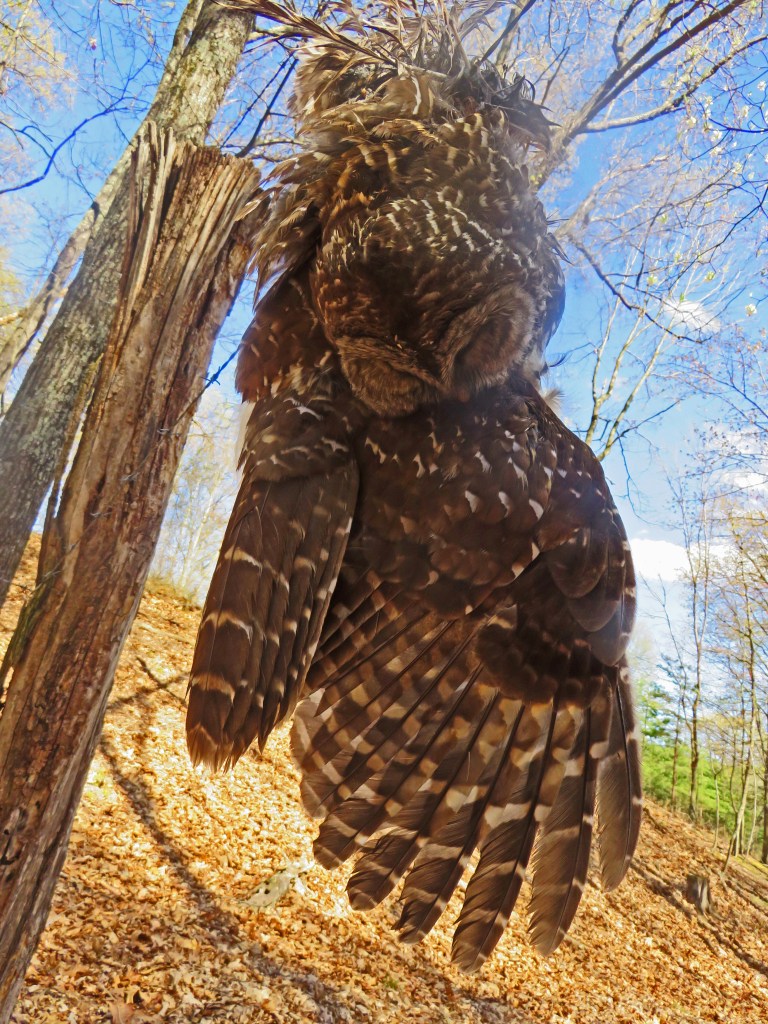
Low Flying Owl 3
by Jim Ross
Sura K. Hassan lives between two coastal cities, Karachi and Istanbul, and finds solace in the works of Paulo Coelho. Her writings primarily focus on relationships, personal mythology, and identity, with splatterings of adjusting to adulthood after a sheltered childhood. Her works have appeared in Welter Journal, Fahmidan Journal, Defunct Mag, and more.
Jim Ross jumped into creative pursuits in 2015 after a rewarding career in public health research. With a graduate degree from Howard University, in eight years he’s published nonfiction, fiction, poetry, photography, hybrid, interviews, and plays in nearly 200 journals on five continents. Photo publications include Barnstorm, Bombay Gin, Burningword, Camas, Feral, Ignatian Literary Magazine, Saw Palm, Stoneboat, Stonecoast, and Whitefish. Text-based photo-essays include Barren, DASH, Kestrel, Ilanot Review, Litro, NWW, Sweet, and Typehouse, with Pilgrimage Magazine forthcoming. He recently wrote/acted in a one-act play and appeared in a documentary limited series broadcast internationally. Jim and family split time between city and mountains.

 Ignatian Literary Magazine